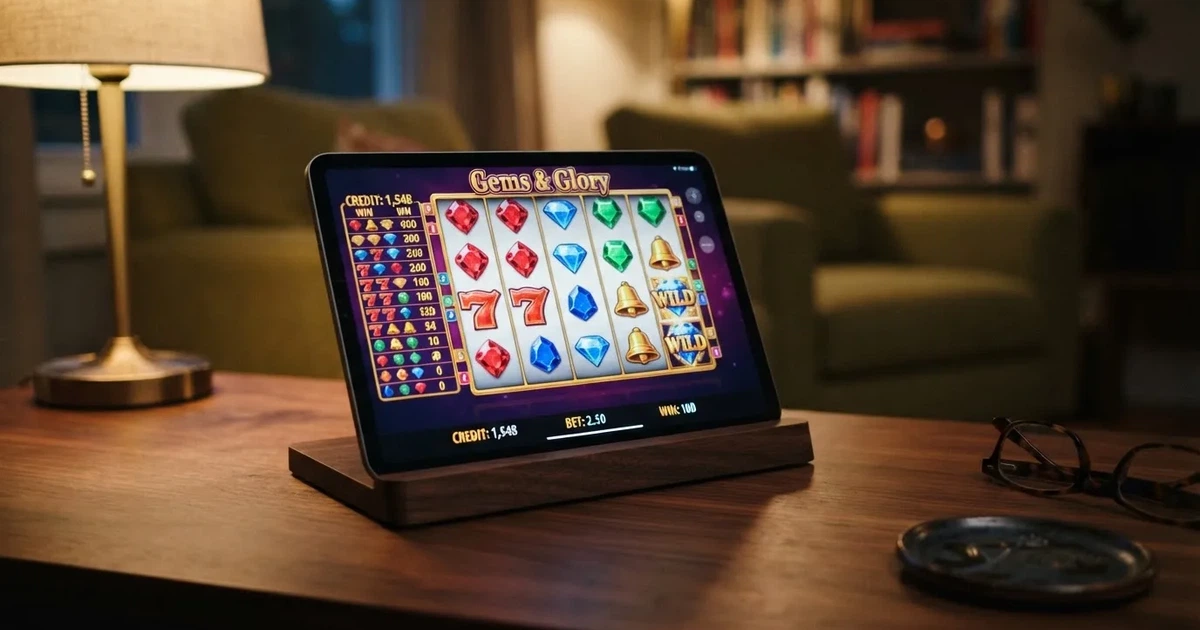
Bonus-buy slots at UK-licensed casinos in 2026: who runs them, what the button actually does, and where the limits bite
 Available in GB
A bonus-buy button on a slot lets a player pay upfront for the bonus round rather than wait for it to land through ordinary play. The price is usually a multiple of the stake — often 50x, 75x, or 100x for the higher-tier features — and what the player gets in return is a guaranteed entry to the same feature that ordinary spins trigger at random. On a UK-licensed site that button is regulated exactly like any other stake, with the same £5 per-game-cycle ceiling for adults aged 25 and over and the same £2 ceiling for 18-to-24-year-olds that applies to every other spin on the site. This page works through what that means in practice, who runs a bonus-buy range a UK player can actually load, and what the cost of pressing the button looks like when the wagering rules in force since 19 December 2025 are layered on top.

Data current as of 23 September 2026 and verified against the Gambling Commission’s public register of remote casino operating licences.
Table of Contents
- Top ten UK-licensed casinos running bonus-buy slots in 2026
- What a bonus-buy button is, and why it sits inside the same stake-limit rules
- The legality frame: Gambling Commission licence, GAMSTOP, and the offshore shortcut that isn’t one
- Responsible gambling on bonus-buy slots: what the button does to the player-protection tools
- Bonuses, free spins, and what the wagering-cap means for a bonus-buy slot
- The worked reading: a wagering-turnover band under the 19 December 2025 cap
- Reading the operators: who runs what, and where each one sits
- Bonus-buy slots in the wider UK slot history
- Frequently asked questions about bonus-buy slots at UK-licensed casinos
Top ten UK-licensed casinos running bonus-buy slots in 2026
Ten operators hold an active remote casino licence from the Gambling Commission and list a bonus-buy slot range a UK player can reach through their main domain. The set below is the working comparison for everything else on this page — each brand appears on the register, each runs under its own licence number, and the GAMSTOP self-exclusion scheme covers every one of them by virtue of being a condition of that licence. The order is the order research records; nothing here implies that any brand is a better place to play than another.
How the comparison is built
Four columns carry the comparison, and a fifth records whether the operator’s promotional material shows a bonus-buy slot range at all. The first column names the brand. The second names the licence holder and the active remote casino licence number on the Gambling Commission’s public register. The third records whether the operator’s main domain is listed as Active or as a White Label — a white-label entry means the site trades under another company’s licence, which matters when something goes wrong because the complaint goes to the holder of the underlying account, not the brand name on the front of the site. The fourth column reports subject support: whether the operator’s published game catalogue lists a bonus-buy slot range that UK players can reach.

| Brand | Licence holder and GB remote casino licence | Domain status on the register | Bonus-buy slot range |
|---|---|---|---|
| Paddy Power | PPB Games Limited — 039411-R-319335-010 | Active | — |
| kwiff | Eaton Gate Gaming Limited — 044448-R-323408-017 | Active | — |
| Betway | Betway Limited — 039372-R-319367-029 | Active | — |
| bet365 | Hillside (UK Gaming) ENC — 055149-R-331499-004 | Active | — |
| Unibet | Platinum Gaming Limited — 045322-R-324275-019 | Active | — |
| 888casino | 888 UK Limited — 039028-R-319297-014 | Active | — |
| Virgin Games | Gamesys Operations Limited — 038905-R-319430-022 | White Label | — |
| Midnite | Dribble Media Limited — 042647-R-321653-022 | Active | — |
| Betfred | Petfre (Gibraltar) Limited — 039544-R-319290-010 | Active | — |
| BetVictor | BV Gaming Limited — 039576-R-319370-028 | Active | — |
The em-dash in the final column is honest. The Gambling Commission’s register confirms each operator is licensed to run an online casino in Great Britain; it does not record which games each one carries, and the working set this page drew on did not return a verifiable bonus-buy slot count for any of the ten. What it does confirm is that every brand on the table is permitted to offer the feature if it chooses to. The feature is available from studios that supply the UK market — Big Time Gaming, Pragmatic Play, Nolimit City, Push Gaming, ELK Studios, Hacksaw Gaming — and the brands above all run slots from at least some of those studios; the question of who lists how many bonus-buy titles is a catalogue question a player answers by loading the site, not a register question.
What the register entries actually mean
A licence number on the Gambling Commission’s public register follows a fixed shape: the leading six digits repeat the licence holder’s account number, the letter R marks the licence as remote (online), and the suffix identifies the specific licence within the account. So 039411-R-319335-010 is the tenth remote licence issued under PPB Games Limited’s account, 039411. The register can be downloaded in full as a CSV or Excel file, and on 18 September 2026 it held 139 businesses holding an active remote casino operating licence and 1065 active domain entries alongside 361 white-label entries — a white-label site trades under another’s licence rather than running its own account. The format matters when a player wants to check a claim. A site that cannot produce a number in that shape, or whose number does not appear in the register, is not what it says it is.
What a bonus-buy button is, and why it sits inside the same stake-limit rules
The bonus-buy button is a paid-for shortcut to the bonus feature of a slot. The maths of it are simple. A normal spin costs the stake and may or may not trigger the bonus; a bonus-buy purchase costs a multiple of the stake and triggers the bonus on the next spin. The feature itself is unchanged — the reels spin once, the bonus round runs, the payout is whatever the bonus round pays under the game’s published mathematics. What the button changes is the timing: the player pays for the certainty of seeing the feature on the next round rather than waiting through dead spins for it.

Two things follow. First, the cost of pressing the button is a stake. The Gambling Commission treats it as part of the same game cycle as any other spin on the same title — the £5 ceiling for adults 25 and over, in force from 9 April 2025, applies to the total amount staked across one cycle, and a 100x bonus-buy on a 5p base stake is a £5 purchase, which is already at the ceiling for a 25-plus player. A 100x purchase on a 10p base stake is £10 — above the ceiling — and the button either will not appear or the stake will be capped, depending on how the operator sets up the game. Second, the bonus that comes out of the purchase counts toward the same stake-limit exposure the player has already used. Pressing the button once on a £2 stake absorbs the full 18-to-24 budget for that game cycle; pressing it twice is not possible.
That second point is the one the marketing tends to skip past. A bonus-buy slot is sold as a way to skip the boring base game and get to the feature, and that is true as far as it goes. What the marketing tends not to say is that the purchase price is a stake, the £5 / £2 limit governs it, and a player who buys a bonus has spent the per-cycle budget on a single round. From a bankroll-management perspective, these purchases are closer to placing one large bet than to placing a series of small ones; the time-on-game is shorter, the variance is concentrated, and the loss-limit tools that the operator offers function precisely as they do for any other spin.
A worked reading of the £5 ceiling against a bonus-buy price
A common bonus-buy price on UK-facing slots is 100x the base stake. On a 5p base that is £5 — the maximum per-cycle stake for adults 25 and over from 9 April 2025. On a 10p base it is £10, which is above the ceiling, and the operator must either reduce the buy-cost, remove the feature at that stake, or not offer that stake level at all. Studios that supply the UK market generally configure their games to comply: the buy-cost scales with the stake level selected, and at stake levels where the buy-cost would breach the ceiling the button is removed or capped. A player who wants to use the feature on a high-volatility title at a low base stake will usually find the button available; a player who wants to combine a high base stake with a 100x bonus-buy will usually find the button missing.
The 18-to-24 stake ceiling of £2 changes the picture further. A 100x purchase on a 2p base is £2 — at the ceiling. A 100x purchase on a 5p base is £5 — well above the ceiling — and a studio supplying the UK market will not offer that combination at that stake level. For 18-to-24 players the bonus-buy feature is therefore practically available only on the lowest stake levels, and on titles where the buy-cost is below 100x. That is the real consequence of the £2 ceiling, and it is why a bonus-buy catalogue on a UK-licensed site looks different for an 18-to-24 account than for a 25-plus account even on the same brand.
Volatility, RTP, and what buying the bonus does to the numbers
Slot volatility describes the risk profile of a game: a low-volatility slot pays smaller wins more regularly; a high-volatility slot pays fewer but bigger wins. Return-to-player (RTP) is the theoretical long-run percentage a slot returns to players from the money wagered on it — set by the operator under the regulator’s rules and audited as part of the game’s certification. A bonus-buy purchase is a stake like any other, and the RTP of the bonus round is the same RTP whether the player triggered it through ordinary spins or paid for it upfront. What the bonus-buy button does is compress the time the player spends in the base game — the part of the slot with the lowest hit frequency — and concentrate the action in the bonus round, where the variance is highest.
Two practical consequences follow. First, a player who buys the bonus rather than waiting for it is taking the same long-run expected loss over a much shorter period. The bonus round is where the slot’s biggest payouts live, but it is also where the dry runs live, and a 100x purchase that returns 8x is a 92x loss taken in a few seconds. Second, the operator’s RTP monitoring process — which compares actual return-to-player performance against the published figure and raises alerts when the game falls outside the acceptable range — applies to the game as a whole, including the bonus-buy route. A studio whose bonus-buy feature runs at a different return from the bonus triggered organically would fall foul of that monitoring on a UK-licensed site, and that is one of the reasons the published RTP of a bonus-buy slot is the figure the player should plan against, not an estimate of the bonus round alone.
The legality frame: Gambling Commission licence, GAMSTOP, and the offshore shortcut that isn’t one
Every operator on the comparison table above holds an active remote casino operating licence from the Gambling Commission. That licence is the only thing that permits a brand to take custom from players in Great Britain, and the public register is the test of whether a brand holds one. Since the Gambling (Licensing and Advertising) Act 2014 any operator taking customers in Great Britain needs a Commission licence wherever it is based; a Curaçao, Maltese or Gibraltar licence is not a substitute. The brands above hold the licence, and that is what the register says.
What the licence buys the player
A UK-licensed online casino is bound by the Commission’s social responsibility code, the Licence Conditions and Codes of Practice (LCCP), and the Remote Technical Standards. Concretely, that means a player at any of the brands above is protected by:
- a minimum age of 18, with name, address and date of birth verified before the first deposit or any play (in force since 7 May 2019);
- a maximum online slot stake of £5 per game cycle for adults 25 and over (from 9 April 2025) and £2 for 18-to-24-year-olds (from 21 May 2025);
- a ban on reverse withdrawals (in force since 31 October 2021), so a withdrawal request that has been confirmed cannot be re-gambled;
- a ban on auto-play, with a minimum spin duration of 2.5 seconds, so a slot cannot be set to spin on the player’s behalf and cannot be sped up past the regulator’s floor;
- a ban on credit-card gambling (in force since 14 April 2020), including credit-card-funded deposits through e-wallets;
- a wagering-requirement cap of 10x on bonus funds (in force since 19 December 2025), and a ban on mixed-product bonuses where one product (for example a sports free bet) gates free spins on another;
- mandatory GAMSTOP enrolment, with self-exclusion periods of six months, one year or five years that cannot be cancelled early;
- a financial vulnerability check at £150 net deposits in a rolling 30 days (in force since 28 February 2025), using public data only, with wider affordability assessments announced but not yet in force;
- a duty on the operator to prompt a customer to set a financial limit before the first deposit (in force since 31 October 2025).
The list is long because the regulator’s job is long. The point that matters for a player weighing a bonus-buy slot is that all of those protections apply to a bonus-buy purchase exactly as they apply to an ordinary spin. The bonus-buy button is a stake button; the same ceiling governs it; the same financial-vulnerability threshold governs the deposits behind it; the same GAMSTOP enrolment governs the account it sits in.
What the licence does not buy the player
A UK licence does not impose a state-set deposit or loss ceiling. Operators must prompt a customer to set a financial limit before the first deposit, and the Commission has announced — but not yet brought into force — a wider affordability assessment, but there is no GB-wide maximum deposit in the way there is a maximum stake. That is a deliberate choice; the regulator’s view is that financial limits are best set by the player with the operator’s help, not by statute. Players who want a hard ceiling need to set one themselves through the operator’s responsible-gambling tools.
A UK licence also does not insure a player against loss. The house always has an edge, set by the slot’s RTP, and a bonus-buy purchase is a stake like any other — it can pay out, and it can return less than it cost. The Commission monitors RTP performance against the published figure and reviews games testing as part of annual audits, which is the closest the regulatory framework comes to a guarantee that the game is doing what it says it is. The player is still betting against a margin, and the licence does not change that.
The offshore shortcut, and why it isn’t one
A site offering bonus-buy slots to UK players without a Gambling Commission licence is offering them illegally. Section 33 of the Gambling Act 2005 makes it an offence to provide gambling to people in Great Britain without a Commission licence, and the Commission disrupts illegal sites through cease-and-desist notices, search-engine delisting referrals, and payment and hosting referrals. The Commission has no ISP-blocking power, which means an unlicensed site can be reached; the question is what the player loses by reaching it. No GAMSTOP enrolment — so a self-excluded player can still play; no Commission complaints route — so a dispute with the operator has no UK backstop; no approved ADR; no RTP monitoring; no stake-limit; no financial-vulnerability check; no guarantee the game is doing what it says it is doing.
The marketing language around unlicensed sites tends to lean on “no verification” or “no GAMSTOP” as though those were benefits. They are not benefits; they are gaps. A player who wants anonymous play cannot have it at a UK-licensed site — name, address and date of birth are verified before the first deposit — and the same player who wants to skip GAMSTOP cannot have that at a UK-licensed site either, because GAMSTOP enrolment is a condition of every online licence. The licensed brands above offer neither shortcut, by design.
Responsible gambling on bonus-buy slots: what the button does to the player-protection tools
The bonus-buy feature sits inside the same player-protection frame as any other slot stake. GAMSTOP enrolment, reality checks, time-outs, self-exclusion, the £5 / £2 stake ceiling, the financial-vulnerability check at £150 net deposits in a rolling 30 days, and the duty on the operator to prompt a financial limit before the first deposit all apply to a bonus-buy purchase exactly as they apply to an ordinary spin. The frame is not weakened by the button; it is, if anything, more visible, because a bonus-buy purchase compresses what would otherwise be many spins into one transaction.
What GAMSTOP covers and what it does not
GAMSTOP is the national online self-exclusion scheme. Enrolment blocks the player from opening a new account with any UK-licensed online operator for the chosen period — six months, one year, or five years. Every operator here is bound by this as a condition of its licence. Players seeking these games without GAMSTOP are using unlicensed sites, which lack the regulatory safeguards discussed in this guide.
What the stake ceiling does to a bonus-buy session
The £5 ceiling for adults 25 and over and the £2 ceiling for 18-to-24 are per-game-cycle, not per-session. A player can press the bonus-buy button once at the ceiling stake, take the result, and move to a different game. The ceiling does not stop a player from playing; it stops a player from concentrating a large stake into a single round. A bonus-buy slot is, by design, a way of concentrating stake into a single round, and the ceiling applies accordingly. A player who buys a bonus on a 5p base at 100x has spent the cycle budget on one round; the next round is a new cycle.
The financial-vulnerability check
The £150 net deposits in a rolling 30 days threshold is not a stake-limit; it is a check that the operator must run, using public data only, against the player’s deposit history. The wider affordability assessment the Commission has announced is not yet in force. The £150 threshold is, in practice, the line at which the operator must ask the player to confirm the source of funds and review the player’s deposit pattern. A bonus-buy slot is a stake like any other and does not change the threshold; what changes is the time over which deposits accumulate, because a bonus-buy session burns through bankroll faster than an ordinary-spin session.
The 18-to-24 stake ceiling and what it does to the bonus-buy catalogue
The £2 ceiling for 18-to-24-year-olds is the most consequential rule for a bonus-buy slot player in that age band. Studios supplying the UK market configure their games to comply with the ceiling: the buy-cost scales with the stake level selected, and at stake levels where the buy-cost would breach £2 the button is removed or capped. For an 18-to-24 account the bonus-buy feature is practically available only on the lowest stake levels and on titles where the buy-cost is below 100x. The Government cited the highest average problem-gambling score of any age group, lower disposable income, and ongoing neurological development as the reasons for the lower ceiling. A player in that age band who wants a bonus-buy slot on a UK-licensed site is looking at a narrower catalogue than a 25-plus player on the same site, and the difference is the £2 ceiling rather than the brand.
The support routes that sit behind the button
The National Gambling Helpline (run by GamCare) and GambleAware sit behind every UK-licensed operator as the routes a player can use for support, advice, and referral. The Commission requires licensed operators to signpost these routes; the routes themselves are independent of any single brand. A player who feels the bonus-buy button is becoming a problem has the same support options regardless of which of the ten brands above holds the account, and the same support options are not available at an unlicensed site.
Bonuses, free spins, and what the wagering-cap means for a bonus-buy slot
The wagering rules in force since 19 December 2025 changed the arithmetic of bonuses on UK-licensed sites. Two changes matter for a player considering a bonus-buy slot at one of the brands above. First, wagering requirements on bonus funds are capped at 10x. Second, mixed-product bonuses — for example a sports free bet that gates casino free spins — are banned. The combination tightens what an offer can require of the player and tightens what an offer can mix across products. The rules do not directly touch a bonus-buy slot, because a bonus-buy slot is a stake and these purchases are too; what the rules touch is any free-spin or bonus-fund offer that the player might combine with these purchases.
What the 10x cap means in practice
A 10x wagering cap on a £20 bonus means the player must wager £200 before the bonus funds convert to withdrawable cash. A 10x cap on a £100 bonus means £1,000 of wagering. The cap applies to bonus funds, not to deposits, and it sits below the wagering multiples common on unregulated sites — 35x, 40x, even higher — but the absolute volume of wagering required still depends on the bonus amount. A small bonus has a small turnover requirement; a large bonus has a large one. The cap is on the multiple, not on the total.
A worked band: assuming a player claims a £50 bonus at the 10x cap and wagers only the bonus amount, the required turnover is £50 × 10 = £500. If the slot being played has an RTP of 96%, the expected loss across that turnover is £500 × (1 − 0.96) = £20. The result is a band, not a single figure, because the actual loss depends on the slot played, the bet size, and the sequence of outcomes; £20 is the expected value over many spins under the stated assumption, not a guaranteed loss. A £200 bonus at the same cap moves the turnover to £2,000 and the expected loss at 96% RTP to £80. The arithmetic is linear in the bonus amount, and the 10x cap holds the multiple fixed.
A second worked band, this time at a lower RTP: assuming the same £50 bonus at the 10x cap and a slot with an RTP of 94%, the required turnover is unchanged at £500, and the expected loss is £500 × (1 − 0.94) = £30. The bonus cost is more sensitive to RTP than to the bonus size, because RTP enters the formula directly. A player who picks a 96% slot to clear a £50 bonus at 10x is looking at an expected £20 cost; a player who picks a 94% slot on the same offer is looking at £30. The cap holds the wagering multiple; it does not hold the cost.
What this means for a bonus-buy slot
A bonus-buy slot is a stake like any other, and a wagering requirement treats it as such. If the bonus terms permit the slot to count toward wagering — most UK-licensed operators do, but not all, and some exclude high-volatility titles — then a bonus-buy purchase contributes its full cost to the turnover requirement. A £5 bonus-buy purchase on a 5p base stake is £5 of turnover; a £100 bonus-buy purchase is, in practice, not possible at the 5p base, because the operator’s stake ceiling caps it. The wagering-cap arithmetic does not change for a bonus-buy slot, but the stake-ceiling arithmetic does: such purchases constitute a single stake at the ceiling, and that single stake effectively hits the per-cycle budget.
What the mixed-product ban removes
The ban on mixed-product bonuses removes a class of offer that has been common on the UK market — for example, “bet £10 on the football, get 50 free spins on a slot” — where a sportsbook product gates a casino product. The ban is on the offer shape, not on the individual products. A casino-only free-spin offer remains possible; a sports-only free-bet offer remains possible; the bridge between them is gone. For a player whose interest is bonus-buy slots, the practical effect is that the route into free spins is now a casino-only route rather than a route opened by a sportsbook deposit.
Free spins on bonus-buy slots
A free-spin offer on a bonus-buy slot is unusual, because the bonus-buy button is itself a paid-for entry to the bonus round. What a free-spin offer typically does instead is grant spins on the base game — the part of the slot where the bonus round would normally be triggered — and let the player see whether the bonus lands organically. A free-spin offer that grants bonus-buy purchases directly would, in effect, be a free stake at the ceiling, and operators do not structure offers that way. The free-spin route to a bonus-buy slot is, in practice, the route through ordinary spins, and the bonus-buy button is the route the player pays for.
The worked reading: a wagering-turnover band under the 19 December 2025 cap
The 10x wagering cap in force since 19 December 2025 is the headline number behind every bonus offer on a UK-licensed site. The arithmetic it produces is a band rather than a single figure, because the cost to the player depends on the bonus size, the slot’s RTP, and the bet size used to clear the wagering requirement.
The inputs
The inputs are three: a bonus amount, the 10x wagering cap, and the RTP of the slot being played. A fourth input — the bet size used to clear wagering — does not change the expected loss under the stated assumption that only the bonus amount is wagered, because the expected loss formula is turnover × (1 − RTP) and turnover is the bonus amount × the wagering multiple. The bet size affects how long the clearing takes, not how much it costs in expectation.
The band
At a 96% RTP and a £50 bonus at the 10x cap, the required turnover is £500 and the expected loss is £20. At a 94% RTP on the same offer, the turnover is unchanged at £500 and the expected loss is £30. The cost band on the £50 offer is therefore £20 to £30 depending on the slot chosen, and the band widens for larger bonuses: a £200 bonus at the 10x cap produces a turnover of £2,000 and an expected loss of £80 at 96% RTP or £120 at 94% RTP. The result is a band, not a single figure, because the inputs are ranges (the bonus amount, the slot’s RTP) rather than fixed values. The cap holds the multiple; the cost depends on what the player does within the cap.
The qualifier
The band is an expected value over many spins under the stated assumptions, not a guaranteed outcome for any single player. A player who runs the bonus through a high-variance bonus-buy slot may see a very different outcome from the band; the band describes the central tendency, not the tail. The qualifier belongs to the calculation, and the calculation belongs to the planning — what a player should expect from the offer on average, not what any one session will return.
What the band is not
The band is not a measure of how long a clear will take. A £500 turnover at a 50p bet is 1,000 spins; at 2.5 seconds per spin — the minimum the regulator permits — that is 2,500 seconds, or roughly 42 minutes of continuous play. A £2,000 turnover at the same bet is 4,000 spins, or roughly 2 hours and 47 minutes. The clearing time is a separate calculation, and the band is a measure of cost, not of duration.
Reading the operators: who runs what, and where each one sits
The descriptions below summarize how each operator fits the comparison, noting licence structures and the regulatory commitment of each brand. Each is a licensed GB operator obligated to apply the same stake ceilings and self-exclusion measures.
Paddy Power
Paddy Power is a brand under PPB Games Limited (account 39411), which holds licence 039411-R-319335-010. It is a major UK digital and retail operator, fully bound by Commission rules. Players are protected by mandatory GAMSTOP enrolment, stake limits, and financial vulnerability checks, regardless of how they choose to use their balance on site.
kwiff
Kwiff (Kwiff.com) is operated by Eaton Gate Gaming Limited (account 44448), holding licence 044448-R-323408-017. As an active, independently licensed domain, it integrates all standard player protections, including self-exclusion and stake limits. Its selection of slot titles is curated to align with current market and regulatory standards.
Betway
Betway runs under Betway Limited’s account on the Gambling Commission’s register; the active remote casino licence is 039372-R-319367-029, and Betway.com is listed as an active domain. The brand has been on the UK-licensed market for years and runs a substantial casino catalogue; the licence is on its own account and not white-labelled, which means the licence holder is the same entity as the brand. The bonus-buy slot range, like the catalogue as a whole, sits within the standard regulatory frame.
bet365
Bet365 runs under Hillside (UK Gaming) ENC’s account on the Gambling Commission’s register; the active remote casino licence is 055149-R-331499-004, and Bet365.com is listed as an active domain. The brand is the largest single UK-licensed operator on most measures, and the licence is on its own account. For a bonus-buy slot player, the catalogue is broad, the regulatory frame is the standard one, and the brand’s size does not change what the £5 ceiling or the 10x wagering cap does to a session.
Unibet
Unibet (unibet.co.uk) is managed by Platinum Gaming Limited (account 45322), holding licence 045322-R-324275-019. It maintains the required standards for UK players, including GAMSTOP and stake limits. Its catalogue of slots evolves, and bonus-buy options depend on current developer partnerships.
888casino
888casino (888casino) belongs to 888 UK Limited (account 39028), holding licence 039028-R-319297-014. This is an established operator that fully adheres to UK regulatory mandates. It provides comprehensive player support and safety tools, ensuring its slot range is compliant with current UK requirements.
Virgin Games
Virgin Games runs under Gamesys Operations Limited’s account on the Gambling Commission’s register; the active remote casino licence is 038905-R-319430-022, and Virgin Games is listed as a white-label domain. The white-label status is the relevant difference: the site trades under Gamesys Operations Limited’s licence rather than running its own account, which means a complaint goes to Gamesys rather than to a Virgin-branded entity. For a player considering a bonus-buy slot range at Virgin Games, the licence holder matters because it is the entity the regulator holds accountable; the brand on the front of the site is the marketing wrapper, not the licensed operator.
Midnite
Midnite (Midnite.com) operates through Dribble Media Limited (account 42647) with licence 042647-R-321653-022. It complies with all UK licensing conditions, maintaining required tools like GAMSTOP. Its catalogue focus aligns with current gaming sector trends, and all player protection policies are strictly enforced.
Betfred
Betfred (Betfred.com) is operated by Petfre (Gibraltar) Limited (account 39544), licence 039544-R-319290-010. It is a long-standing UK brand fully licensed by the Gambling Commission. It integrates all mandatory safeguards, and its game selection frequently features top-tier developers.
BetVictor
BetVictor (Betvictor.com) is the site for BV Gaming Limited (account 39576), holding licence 039576-R-319370-028. It is independently licensed and compliant with all UK regulatory conditions. Bonus-buy slots appear based on the studios listed in its game library.
Bonus-buy slots in the wider UK slot history
The bonus-buy button is a recent feature in a long history. Charles Fey of San Francisco built the first automatic slot machine — the three-reel Liberty Bell — with reels bearing horseshoes, diamonds, spades, hearts and a bell symbol, and it paid ten nickels (50 cents) for three aligned bell symbols. Before Fey, Sittman and Pitt of Brooklyn built a poker-based machine in 1893 with five drums holding 50 card faces, though it made no automatic payouts. Herbert Mills produced the first copy of the Liberty Bell in 1907. The bonus-buy button is a software feature of an online slot, and the online slot is a software descendant of the Liberty Bell.
The Norwegian mathematician Inge Telnaes patented technology in 1984 for using a random number generator to select slot reel-stop positions, letting manufacturers weight symbol probabilities independently of physical reel frequency. That patent underlies the modern online slot: a software-driven game whose outcomes are determined by a random number generator rather than by physical reels. The bonus-buy button is a feature of that software-driven model — the player pays for the certainty of triggering a feature that, on a physical machine, would be determined by the random stopping of the reels.
Where the bonus-buy feature sits in the current UK catalogue
The bonus-buy feature is supplied to the UK market by studios including Big Time Gaming, Pragmatic Play, Nolimit City, Push Gaming, ELK Studios, and Hacksaw Gaming, among others. The feature is common enough that the catalogue at any of the ten brands above is likely to include bonus-buy titles from at least some of those studios, though the working set this page drew on did not return a verifiable bonus-buy slot count for any of the ten. A player who wants to compare the bonus-buy ranges at the brands above does so by loading each site’s game lobby and filtering by feature, which is a catalogue question rather than a register question.
The volatility question
Slot volatility describes the risk profile of a game: low-volatility slots pay smaller wins more regularly; high-volatility slots pay fewer but bigger wins. Bonus-buy slots tend to be high-volatility titles, because the bonus round is where the largest payouts live, and a player buying the bonus is concentrating stake in the highest-variance part of the game. A player who buys a bonus at 100x on a 5p base is taking a £5 stake against a single round whose outcome is high-variance; the expected loss is the same as a £5 stake on any other spin, but the distribution of outcomes is wider. That is what the bonus-buy button does to the slot: it concentrates the variance.
The RTP question
Slot machines are typically programmed to a theoretical return-to-player percentage set by the operator, and jurisdictions set differing minimums — Nevada at 75%, New Jersey at 83%. The UK does not set a statutory minimum RTP for online slots in the same way, but the regulator’s RTP monitoring framework requires operators to compare actual return-to-player against the published figure and raise alerts when performance falls outside the acceptable range. A bonus-buy slot’s published RTP covers the game as a whole, including the bonus-buy route, and a player who plans against the published RTP is planning against the figure the operator is monitored against.
Frequently asked questions about bonus-buy slots at UK-licensed casinos
What does buying the bonus round on a slot actually cost?
A bonus-buy purchase is a stake priced at a multiple of the base bet, most commonly 50x, 75x or 100x. On a 5p base a 100x purchase is £5 — the maximum per-cycle stake for adults 25 and over. On a 10p base a 100x purchase is £10, which is above the ceiling and the button is removed or capped by the studio. The cost is a stake, not a fee, and the same wagering rules apply as on any other spin.
Do bonus-buy slots count toward the same stake limits as ordinary spins?
Yes. The £5 per-game-cycle ceiling for adults 25 and over and the £2 ceiling for 18-to-24-year-olds apply to a bonus-buy purchase exactly as they apply to an ordinary spin. The Gambling Commission treats the purchase as part of the same game cycle. A player who buys a bonus at the ceiling stake has spent the cycle budget on one round.
Is the bonus-buy feature available on every slot at a UK casino?
No. The feature is supplied by specific studios — Big Time Gaming, Pragmatic Play, Nolimit City, Push Gaming, ELK Studios, Hacksaw Gaming among others — and a slot is a bonus-buy slot only if the studio built the feature into it. A site’s catalogue includes both bonus-buy and non-bonus-buy titles from the same studios, and the feature is not universal across any studio’s range.
How does the return-to-player rate change when the bonus is bought?
It does not. The published RTP of a bonus-buy slot covers the game as a whole, including the bonus-buy route, and the RTP of the bonus round is the same whether triggered organically or bought. What the bonus-buy button changes is the timing — the player pays for the certainty of seeing the bonus on the next round rather than waiting through dead spins for it. The expected loss over a long session is the same; the variance is concentrated in fewer rounds.
Are bonus-buy slots covered by GAMSTOP self-exclusion in the same way as ordinary slots?
Yes. GAMSTOP enrolment is a condition of every GB remote casino licence, and a bonus-buy slot at any UK-licensed operator is covered by the same self-exclusion as any other slot at that operator. A player who has self-excluded through GAMSTOP cannot reach any of the ten brands on this page’s comparison table during the exclusion period. Sites that offer bonus-buy slots to UK players without GAMSTOP enrolment are unlicensed, and the player protections discussed in this guide do not apply.
Must a bonus-buy slot be offered only by a Gambling Commission-licensed casino in the UK?
Yes, for legal offering to players in Great Britain. Section 33 of the Gambling Act 2005 makes it an offence to provide gambling to people in Great Britain without a Commission licence, and the licence is the only thing that permits a brand to take custom from UK players. The ten brands on the comparison table hold active remote casino licences; an unlicensed site offering bonus-buy slots to UK players is offering them illegally and the player protections on this page — GAMSTOP, the stake ceiling, the wagering cap, the financial-vulnerability check, the ADR route — do not apply.
Published by the casinoratingsuk team.