
A debit card at a British online casino: what the rules actually do to your money
 Available in GB
A licensed UK casino treats a debit card like any other funding route: a deposit lands in your balance in seconds, the same amount leaves your bank account the same moment, and a withdrawal back to the same card takes minutes to a few working days, depending on who you bank with. What changes in 2026 is not the funding itself but the rules wrapped around it — the 10x wagering cap on bonuses, the £5/£2 slot-stake tier by age, and the financial-vulnerability trigger that fires once your deposits cross £150 in a rolling 30 days.
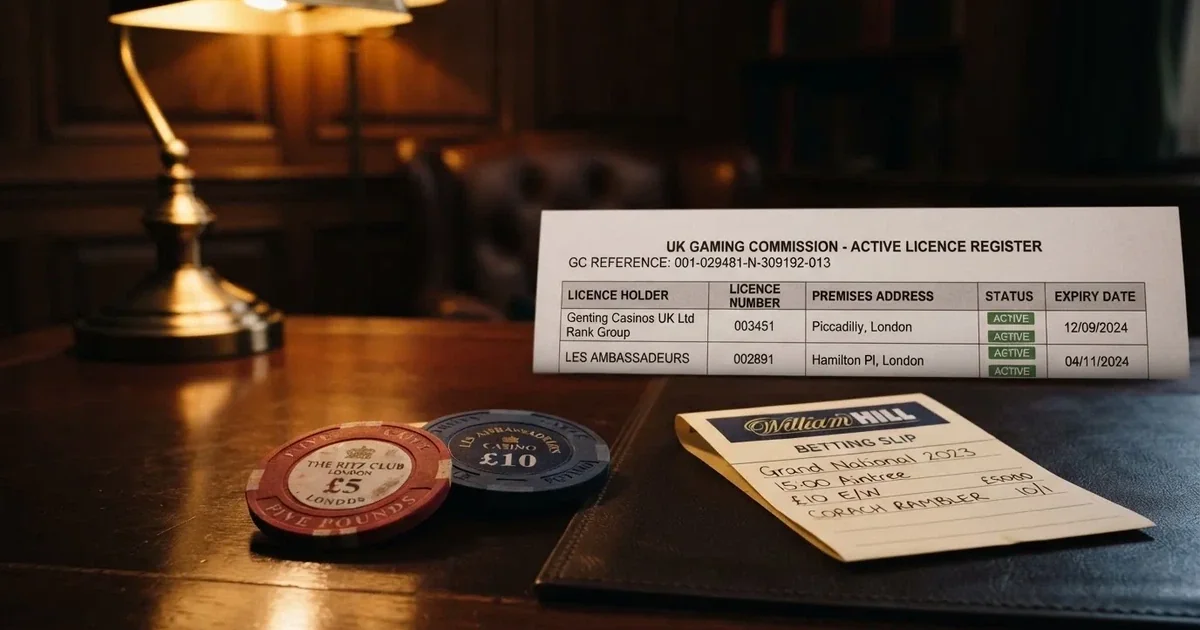
Current as of 23 September 2026 against the Gambling Commission’s public register of gambling businesses.
Table of Contents
- Settlements at the till: ten GB-licensed operators, ranked and explained
- A debit card in plain terms: what the network, the bank and the casino each do
- Licence fundamentals: what the Gambling Commission register actually certifies
- Safeguards by default: the limits, checks and GAMSTOP that apply to every account
- Money in, money out: how a debit card deposit and withdrawal really move
- Jurisdictional profiles: the ten operators, licence by licence
- The 10x wagering cap: turnover bands under the December 2025 rule
- Frequently asked questions
Settlements at the till: ten GB-licensed operators, ranked and explained
The Gambling Commission’s public register listed 139 businesses holding an active remote casino operating licence on 18 September 2026. The ten that follow are pulled directly from that register, each cross-checked against the active domain entry beside it. The register is the only place a licence claim can be settled in writing; the homepage is not.
These are ten trading names, not ten independent licence holders. PPB Games Limited runs Betfair. Rank Interactive (Gibraltar) Limited runs Grosvenor Casinos. LC International Limited runs Gala Bingo, and that same company is the parent that holds the licence behind Ladbrokes and Coral as well — three brand names on the high street sharing one remote licence account. Stars Interactive Limited runs PokerStars. Tek Fox Ltd runs MrQ. Reading the licence numbers below is reading the structure of the GB-licensed market in microcosm.
| Brand | Position | Licence holder | Remote casino licence | Register status |
|---|---|---|---|---|
| Betfair | Sportsbook and casino | PPB Games Limited | 039411-R-319335-010 | Active |
| kwiff | Sportsbook and casino | Eaton Gate Gaming Limited | 044448-R-323408-017 | Active |
| 888casino | Casino only | 888 UK Limited | 039028-R-319297-014 | Active |
| Grosvenor Casinos | Casino and land estate | Rank Interactive (Gibraltar) Limited | 057924-R-334666-005 | Active |
| Gala Bingo | Bingo-led casino | LC International Limited | 054743-R-330863-014 | Active |
| Virgin Games | Casino (white-label) | Gamesys Operations Limited | 038905-R-319430-022 | White Label |
| PokerStars | Casino and poker | Stars Interactive Limited | 039108-R-319334-026 | Active |
| 32Red | Slot-led casino | Platinum Gaming Limited | 045322-R-324275-019 | Active |
| bet365 | Full product stack | Hillside (UK Gaming) ENC | 055149-R-331499-004 | Active |
| MrQ | Casino only | Tek Fox Ltd | 060629-R-337532-004 | Active |
The format is the register’s own. A licence number has the form (account)-R-(number)-(suffix) where the leading six digits repeat the licence holder’s account number, the R marks a remote (online) licence, and the suffix counts reissues. Reading 039411-R-319335-010 for Betfair: PPB Games Limited sits at account 39411, the R marks the licence as remote, and the suffix shows this is the tenth reissue. The same shape applies to every entry in the table — the licence is the asset, and the suffix is its renewal history.
Nine of the ten sit as Active entries — meaning the operator’s own licence and the operator’s own domain back the brand. Virgin Games is the exception: the register marks it White Label, meaning the brand trades under another company’s licence (Gamesys Operations Limited at account 38905). The licence is real, the protections are the same as for any other GB-licensed site, and the only thing the white-label flag changes is that the trading brand is not itself the legal counterparty.
The wider register, of which these ten are a sample, logged 1,065 active and 361 white-label domain entries on 18 September 2026, all of them held by one or another of the 139 licensed businesses. A reader who sees a familiar brand advertised but cannot find it on the register is not looking at a licensed site — they are looking at a clone, a mirror or an offshore site, and that is exactly what the register is meant to catch.
What the table cannot show is the practical consequence of choosing one of these ten over another. The licence, the operating company and the register status all look the same on paper. What changes between them is the catalogue of games, the terms on the welcome offer, the speed of the live-chat queue, and the ceiling the player sets themselves. None of that is on the register. It is in the operator’s terms page and in the reality of using the site, and that is where the rest of this article goes next.
A debit card in plain terms: what the network, the bank and the casino each do
A debit card is not a credit card with a different name. It draws money from the cardholder’s bank account at the time of the transaction, and it does not defer payment to a statement cycle. A credit card does, and a credit card has not been a permitted funding method for any UK gambling transaction since 14 April 2020 — including credit-card balances routed through e-wallets, which the regulator closed off as well. Anyone landing on a UK casino’s cashier and seeing “credit card” listed as a deposit method is not at a properly licensed operator.
The five dominant card networks globally are Visa, Mastercard, American Express, Discover and UnionPay. In day-to-day UK online gambling, two of those networks carry almost all of the volume: Visa debit and Mastercard debit. American Express is on some operators and declined by others; Discover and UnionPay are uncommon in this market. The Switch and Solo networks that used to carry many UK high-street cards have been rebranded as Maestro for international compatibility — the brand on the front of the card has shifted, the underlying network has not.
The thing a player actually experiences is the stack, not the network: the card the bank issued, the network that moves the transaction, the merchant (the casino), and the merchant’s acquiring bank. Each layer can apply its own checks, decline paths or limits. A blocked deposit is rarely the casino’s decision. It is usually one of three things: the bank’s gambling block, the merchant-category code the casino is classified under, or the cardholder’s own fraud settings.
Several UK banks — Barclays most visibly — let the cardholder block gambling transactions on a specific card from inside the app. Barclays exposes this under a “Manage your cards” section; the bank will block payments it can detect to operators it can identify, and the customer remains responsible for any transaction the system cannot classify. Other high-street banks have followed with similar controls. The consequence for a player is that a deposit can fail without explanation: the casino sees a declined transaction, not the reason. The reason sits in the customer’s banking app, not at the cashier.
This is also why a debit card looks different from a credit card at the cashier. The 14 April 2020 ban does not say “credit cards” as a colloquialism. It is an explicit Commission rule: a credit-balance deposit, including via an e-wallet funded from a credit card, is prohibited at any GB-licensed operator. A debit card draws on current-account money and is the only mainstream way a UK player funds an account at all. The whole shape of this market sits on that fact.
The fintech challenger banks that have grown over the last decade — Monzo, Starling, and the various “neobanks” since — issue Visa or Mastercard debit cards as standard. Monzo received its full UK banking licence from the Prudential Regulation Authority and the FCA in April 2017, having launched on a restricted licence with prepaid cards on 18 February 2015. Starling received its UK banking licence in July 2016 and reported total assets of £16.6 billion as of 2026. Both banks handle gambling transactions through the same merchant-category-code path as a high-street bank, and both apply their own merchant-level controls. A Monzo card and a Barclays debit card look identical at the cashier; the bank’s app decides which ones go through.
A wallet on top of a card is a different object and behaves differently. Apple Pay launched on 20 October 2014 with US-issued cards only, and supported UK-issued cards from 14 July 2015. It works by tokenising the underlying card number — a device-specific Device Primary Account Number replaces the card number, and a dynamic security code is generated per transaction — so a debit card registered to Apple Pay is, from the casino’s perspective, a card transaction verified through the wallet’s biometric step. In an online casino’s cashier, Apple Pay sits as a card-funded option even though the user is authorising the payment with a Face ID or Touch ID double-click rather than a card number.
The implication is that a player who has set up Apple Pay with a debit card does not see a different route from the player typing a card number. The casino sees a card-network transaction either way; the regulator sees a card deposit either way. The bonus terms, the wagering requirements, the £5/£2 stake tier and the GAMSTOP machinery all apply to both routes identically.
What the cashier cannot tell a player, and what the next sections will, is which side of those mechanics the regulator actually enforces. A debit card looks like a choice at the top of the deposit page; in practice, every step of the journey from the card to the slot machine is governed by the rules that follow.
Licence fundamentals: what the Gambling Commission register actually certifies
A casino taking deposits from a customer based in Great Britain must hold a Gambling Commission licence, wherever the operator is incorporated. That is the legal position since the Gambling (Licensing and Advertising) Act 2014, and it is the reason a Curaçao, Maltese or Gibraltar-issued licence is not enough on its own — these jurisdictions license their own operators, but none of them licenses a business to take bets from people in Great Britain unless the Gambling Commission also licenses that business. Section 33 of the Gambling Act 2005 makes providing gambling to people in Great Britain without a Commission licence a criminal offence; the Commission’s enforcement tools include cease-and-desist notices, payment and hosting referrals, and search-engine delisting referrals, but the regulator has no ISP-blocking power.

The test of whether a brand is licensed is one lookup. The Gambling Commission’s public register is searchable online and downloadable in full as CSV or Excel. It recorded 139 businesses holding an active remote casino operating licence on 18 September 2026, and on the same date logged 1,065 active and 361 white-label domain entries against those 139 licence accounts. A white-label entry means the brand trades under another company’s licence — the site is real, the licence is real, the protections apply, but the legal counterparty behind the brand is not the brand itself.
The way to read a Commission licence number is the way to read a passport: the format is fixed and the digits are not random. A remote casino licence has the form (account)-R-(number)-(suffix). The leading six digits repeat the licence holder’s account number, the R marks the licence as remote (online), and the suffix counts how many times the licence has been reissued. Reading 060629-R-337532-004: the licence holder sits at account 60629, the licence is a remote casino licence, and this is the fourth issue of that particular licence number. The number sits on the operator’s own terms page; the register is the source it points back to.
The register’s domain status — Active, Inactive or White Label — is what catches the rest. An Inactive entry is a domain a licence holder once used and no longer uses; an Active entry is a domain the holder currently operates under that licence; a White Label entry is a third-party brand trading under the licence holder’s permission. The 1,065 active and 361 white-label numbers on 18 September 2026 mean roughly one in four entries the register holds is a brand the licence holder does not own outright. A reader who lands on a site that names one company on its terms page but lists a different company on the register is not looking at a misalignment — that is the standard structure of the market.
A licence number without a domain to anchor it is not, on its own, evidence of anything. The licence number says who the licensed business is; the domain list says which sites that business actually runs. A reader looking up a brand by its licence number is checking the trading-name-to-licence mapping; a reader looking up a brand by its domain is checking the site-to-licence mapping. Both checks are valid, and the register supports both. The audit a curious player can run in five minutes on the Commission’s website does more than most marketing pages ever will to settle the question of who they are actually paying.
The Commission is sponsored by the Department for Culture, Media and Sport and operates under the Gambling Act 2005, which covers England, Scotland and Wales but not Northern Ireland. The split matters when a player sees a licence number beginning with the prefix for Northern Ireland — those are issued under different legislation and are not interchangeable. Every GB-licensed remote operator in this article is licensed under the Commission’s GB regime.
Anonymous play is not possible at a Commission-licensed site. Since 7 May 2019, every licensed operator has had to verify a customer’s name, address and date of birth before accepting the first deposit or allowing any play. The verification is not a “document upload at withdrawal” — it sits at the top of the journey, before any money is committed. A licensed site that lets a player in without it is failing its licence conditions; the consequence for the player, in the rare event it happens, is that the casino will face Commission action, and the player should not expect the first deposit to remain the only money on the line.
What a licence does not do is endorse the operator’s terms. A licensed casino can run a punishing bonus, a slow live chat and an aggressive withdrawal review; the licence does not pass judgement on those. The Commission’s role is the structural one: it checks the operator’s solvency, its anti-money-laundering systems, its self-exclusion machinery, and its adherence to the social responsibility code. The experience of using the site is governed by the operator’s own terms and by the consumer-rights framework that sits behind any UK retail contract.
The register is the smallest test a player can run. A brand that fails it has no other test to pass.
Safeguards by default: the limits, checks and GAMSTOP that apply to every account
Every licensed site runs the same baseline of player-protection machinery, regardless of how the player funded the account. The machinery is not an optional layer the casino can leave off; it is a condition of holding a Commission licence. A debit card deposit triggers the same safeguards as any other deposit method, and a player who knows what those safeguards are before they fund their account is a player who will not be surprised by them in the middle of a session.
The age floor is 18. There is no operator in this market licensed to take a bet from a customer under 18, and the verification that gates that age runs before the first deposit. The casino is also obliged, since 7 May 2019, to check name, address and date of birth against the same set of records before any money leaves the customer’s account. A player who has set up the account properly will not notice any of this; a player who has not will be stopped at the cashier.
GAMSTOP is the national online self-exclusion scheme, and it is a mandatory condition of every online licence since 31 March 2020. A player who has registered with GAMSTOP for six months, one year or five years cannot open an account at a Commission-licensed casino, cannot deposit into one, and cannot continue to play at one if the registration lands mid-session. The exclusion cannot be cancelled early: a five-year exclusion is a five-year exclusion, regardless of what the player asks for on day 31. The exclusion is nationwide, which is the whole point of a centralised register — one self-exclusion entry closes every licensed site, not just one brand. A licensed casino that lets a self-excluded player through is failing the most basic test of its licence.
Stake limits on online slots are set by statute, not by the operator. The £5 maximum stake per game cycle for players aged 25 and over came into force on 9 April 2025, and the £2 ceiling for 18-24s came into force on 21 May 2025. A game cycle is one spin in a slot — the bet placed on a single round, before any cascading or tumble-style mechanics reset it. The £5 cap is a hard ceiling, not a default the player can opt out of by raising it; an operator that lets an over-25 player stake £10 on a single spin is breaking the rule.
Auto-play has been banned since 31 October 2021. A slot cannot spin itself; the player has to take the action between rounds. The minimum spin interval is 2.5 seconds — the gap between one spin starting and the next spin starting — and losses disguised as wins are banned as well. A “losses disguised as wins” pattern is one where the slot’s audiovisual feedback celebrates a payout smaller than the stake, so the player sees a win animation for a balance that has actually gone down. It is the kind of mechanic the social responsibility code specifically prohibits.
There is no state-set deposit or loss ceiling at a UK-licensed casino. The Commission does not impose a maximum a player can deposit per day, week or month; the operator must, however, prompt the customer to set a financial limit before the first deposit (in force from 31 October 2025). The prompt is a hard gate: the player cannot reach the cashier without responding to it. The limit they set is their own, and the casino must honour it — a player who set a £100 weekly deposit ceiling and is told, in week two, that the casino is willing to raise it has just been pitched against its own licence condition.
Financial vulnerability checks are the next layer. Since 28 February 2025, an operator must run a financial vulnerability check using public data once a customer’s net deposits cross £150 in a rolling 30-day window. The check is light-touch and uses public data only; the operator is looking at publicly visible markers of financial distress (court judgments, insolvency registers, the kind of surface a basic Companies House search would surface). Wider financial-risk assessments are announced but not yet in force, so the £150 trigger is the present-tense rule. A player who crosses £150 in a rolling 30-day window should expect a friction point — a prompt, a delay, an email — even if everything is in order.
National Gambling Helpline, run by GamCare, and GambleAware are the two signposted routes a player in distress can use. Both are signposted from every licensed operator’s responsible-gaming page; both sit alongside GAMSTOP rather than instead of it; both take calls or webchats from anyone, regardless of whether they have registered for self-exclusion. The point of these layers is not to be a net that catches every player — it is to be a net that catches the player who is about to fall, before the fall.
The casino’s own deposit limit and reality-check prompts sit on top of all of this. A reality check is a periodic pop-up that asks the player how long they have been in session and what their net position is; it interrupts the spin loop and forces a conscious decision to continue. The Commission requires reality checks at intervals that depend on session length, and the casino is not allowed to bury the prompt in a sub-menu or behind a “remind me later” option that resets the clock. The same machinery runs on a debit-card-funded account as on any other, and the player who expects anything different at the cashier is expecting a casino that does not have a Commission licence.
Money in, money out: how a debit card deposit and withdrawal really move
A debit card deposit credits the casino balance in seconds. The card transaction itself takes a moment to authorise — a chip-and-PIN check, a 3-D Secure step on some networks, the merchant’s acquiring bank returning an approval code — and once that approval is back, the casino’s internal ledger updates and the player sees the funds. The practical consequence is that a £10 minimum deposit and a £5 stake are indistinguishable from the player’s perspective; both clear before the slot’s loading screen has finished. The bank sees the transaction at the same moment the casino credits the balance, so the £10 leaves the current account in real time and not on a statement cycle.
A debit card withdrawal reverses the same flow with one important change: the casino must approve the payment from its own account, and only then does the card network push the funds back to the issuing bank. From the player’s perspective, the gap between “withdrawal requested” and “money back in the bank account” is governed by the casino’s own processing time, plus the issuing bank’s own clearing time, plus any extra time the bank takes to release the funds into the current account.
A “withdrawal back to debit card in minutes” promise is real for some operators and aspirational for others. The fastest end of the market — operators running their own payments rails on the Visa Direct or Mastercard Send rails — sees money back in the current account in under an hour, sometimes within minutes. The middle of the market settles on same-day to next-working-day, which is also the realistic experience for a first withdrawal at an operator the player is new to: the casino’s anti-fraud review runs before the first payout is sent, and that review can take up to 24 hours even at a fast operator.
A first withdrawal at any licensed operator triggers the casino’s source-of-funds and identity checks in earnest. The casino has to be satisfied that the funds being withdrawn are not the proceeds of crime, that the player’s identity matches the verification it ran on sign-up, and that no self-exclusion, time-out or limit has been breached in the meantime. None of this is the casino looking for a reason to decline the withdrawal — it is the casino meeting its anti-money-laundering obligations — but it does mean that the first withdrawal is always slower than the tenth. A player who has set up the verification cleanly on day one will not notice it on day one hundred; a player who has not will feel it on day one hundred.
Bonuses — where the operator offers any — sit on top of all of this. Since 19 December 2025, the Commission’s rules have capped wagering requirements at 10x and banned mixed-product bonuses (a free bet on sport bundled with a casino spin, for instance). The cap is on the bonus amount, not on the deposit; the cap applies to the multiplier a player has to roll the bonus through before any winnings become withdrawable. A 10x cap on a £100 bonus is a £1,000 turnover requirement; a 10x cap on a £1,000 bonus is a £10,000 turnover requirement. The cap is the same, and the absolute pound figure is very different.
The “no credit card” rule — in force since 14 April 2020 — is what makes the debit card the default. A licensed casino cannot accept a credit-balance deposit, including a credit balance that has been routed through an e-wallet. A player trying to fund a UK account with a credit card will see the transaction declined at the cashier, regardless of whether the operator’s terms nominally list credit cards among accepted methods. The ban is one of the cleanest cross-method rules in the market: a player who is using a debit card is already on the right side of it.
What a licensed casino will not do, and what an unlicensed one will, is the question the next section answers. A licensed casino will not let a player in without identity verification, will not bypass GAMSTOP, will not raise the £5/£2 stake limit on request, will not waive the £150 financial-vulnerability trigger, will not run a mixed-product bonus, will not raise wagering requirements above 10x. An unlicensed casino will let a player do all of those things, because none of the safeguards in this section are binding on an operator that has no Commission licence to lose.
Jurisdictional profiles: the ten operators, licence by licence
The ten operators that follow sit in the table above as licence numbers. What follows is what each licence actually means for a player who is about to use the site — the operating company, the licence number, the place the brand sits in the parent-group structure, and one or two practical facts a reader can act on. Each profile ends on the page’s own judgement of the brand.

Betfair — PPB Games Limited, full-stack product under licence 039411-R-319335-010
PPB Games Limited, account 39411, holds the licence. The Betfair site domain is listed as Active on the register. The licence has been reissued ten times, placing PPB Games Limited among the longer-tenured remote operators in the GB market.
The catalogue is the deepest of the ten: sportsbook, exchange, poker, casino and games sit under one roof, and the casino tab is one layer of a wider product. The same account funds the slot machine and the football coupon. The 19 December 2025 mixed-product bonus ban means a “bet £10 on football, get 50 casino spins” structure is no longer permitted at any Commission-licensed operator, and Betfair’s offer pages have separated into a sportsbook welcome and a casino welcome as a result.
The brand premium at Betfair buys the breadth. The licence does the regulatory work the player already has at every other operator in this table.
kwiff — Eaton Gate Gaming Limited, surprise-bet sportsbook under 044448-R-323408-017
Eaton Gate Gaming Limited, account 44448, holds the licence. The site is an active domain entry for kwiff. It has been reissued 17 times, one of the higher reissue counts in the table.
The brand’s signature product — surprise bets, surprise boosts — is a sportsbook mechanic; the casino sits alongside it. The same 10x bonus cap and mixed-product ban apply. A kwiff welcome offer cannot bundle a casino spin with a sportsbook free bet any more, regardless of which product the player uses first.
The 17-times-reissued licence is the structural asset. The surprise-bet mechanic is the brand-specific feature, and the casino sits underneath it.
888casino — 888 UK Limited, casino-only brand under 039028-R-319297-014
888 UK Limited, account 39028, holds the licence, which is an active domain for 888casino. This licence has undergone 14 reissues.
888 is one of the longer-tenured casino-only brands in the GB market. The Group’s history outside the UK is longer still, but the relevant licence for a Great Britain customer is the one above and only that one. The 888 UK entity is the legal counterparty on the player’s account.
The catalogue depth is the differentiator at 888. The licence does the same regulatory work any 14-times-reissued Commission entry does — no more, no less.
Grosvenor Casinos — Rank Interactive (Gibraltar) Limited, land estate and online skin under 057924-R-334666-005
Rank Interactive (Gibraltar) Limited, account 57924, is the licence holder, operating Grosvenor Casinos as an active domain. The licence has been renewed five times.
Grosvenor runs a real-world casino estate alongside the online casino; the online product is a separate skin of the wider Rank Group’s remote operation. The licence is Gibraltar-incorporated and Commission-licensed, which is the standard structure for GB-regulated Gibraltar-based operators — the Commission licences the operator, the operator is a Gibraltar company, and the Commission is the regulator for GB customers.
The land-based estate is the cross-channel asset at Grosvenor. Loyalty points earned at the casino floor can be redeemed online, and the same Commission licence governs both sides.
Gala Bingo — LC International Limited, bingo-led parent of Ladbrokes and Coral under 054743-R-330863-014
LC International Limited, account 54743, holds the licence, with Gala Bingo listed as an active domain. It has been reissued 14 times.
LC International is the parent company behind Ladbrokes and Coral; the three brands sit under one licence holder, and moving between them is staying inside one legal entity. The brand is bingo-led — the slots tab is a layer on top — but the licence, the GAMSTOP machinery, the £5/£2 stake tier and the 10x bonus cap apply to it identically.
The parent-group structure is what a player is choosing at Gala Bingo. Three of the most familiar names on the UK high street sit under LC International, and the licence is the asset that ties them together.
Virgin Games — Gamesys Operations Limited, the table’s only white-label under 038905-R-319430-022
Gamesys Operations Limited, account 38905, holds the licence. The register marks the Virgin Games site as a White Label domain — the brand trades under the Gamesys licence. The licence has been reissued 22 times, the highest reissue count in the table.
A white-label structure is not a lesser licence. The protections are identical to any Active entry. The only difference is the legal counterparty: the player’s contract is with Gamesys Operations Limited, not with the Virgin brand on the homepage.
The white-label flag is the choice at Virgin Games. The licence holder behind the brand is Gamesys Operations Limited, and nine other entries in the table sit as Active rather than white-label — that is the structural choice the player is making.
PokerStars — Stars Interactive Limited, longest-running remote licence under 039108-R-319334-026
Stars Interactive Limited, account 39108, operates PokerStars under an active domain entry. This licence holds the record for the highest reissue count in the table, with 26 renewals.
The brand’s primary product is poker; the casino tab sits alongside it. The mixed-product bonus ban means a player at PokerStars cannot claim a sportsbook-bundled casino offer any more, regardless of which tab the player uses.
The 26-times-reissued licence is the longest-running remote casino licence in the table. For a player who wants casino and poker on one account, the licence depth is the asset. For a casino-only player, the brand premium is being paid for a product the player is not using.
32Red — Platinum Gaming Limited, slot-led catalogue under 045322-R-324275-019
Platinum Gaming Limited, account 45322, holds the licence. The 32Red site domain is listed as Active. The licence has been reissued 19 times.
The brand is casino-only and slot-led; the wider Kindred Group structure sits above Platinum Gaming, and a player choosing 32Red is staying inside the Group’s GB-facing arm. The 19-times-reissued licence is older than most in the table, which is the structural fact the table shows that a player cannot easily check elsewhere.
The slot-led catalogue is the point at 32Red. The licence has the same regulatory effect as any long-tenured Commission entry; the catalogue is what differs.
bet365 — Hillside (UK Gaming) ENC, full product stack under 055149-R-331499-004
Hillside (UK Gaming) ENC, account 55149, holds the licence. The bet365 site domain is listed as Active. The licence has been reissued four times, among the lower counts in this list.
The brand is one of the deepest product stacks in the market — sportsbook, exchange, casino, poker, bingo, games — and the casino tab is one layer of a wider operation. The licence covers all of it, and the Commission’s bonus and stake rules apply across the whole product.
The product depth is the asset at bet365; the four-times-reissued licence is the lower-tenure end of the table. For a player who wants one account for the full product stack, the licence and the brand are aligned. For a player who wants the longest-tenured licence on the casino tab alone, the table has longer-tenured options.
MrQ — Tek Fox Ltd, most recent licence with no-wagering bonuses under 060629-R-337532-004
Tek Fox Ltd, account 60629, holds the licence. The MrQ site domain is listed as Active. The licence has been reissued four times, the same reissue count as bet365.
MrQ is the only operator in the table whose licence number is from an account in the 60,000 range — the higher account numbers on the register correspond to operators that have come into the GB market more recently. MrQ is the most recently registered licence among the ten. The brand’s no-wagering bonuses sit below the Commission’s 10x cap rather than above it; the cap is a ceiling on the requirement, and an offer with no wagering at all is below it.
The account number is the highest in the table, which makes MrQ the youngest licence by that measure. The no-wagering offer is the brand-specific feature, and its relationship to the cap is the structural detail that matters.
The 10x wagering cap: turnover bands under the December 2025 rule
The 10x cap on wagering requirements, in force since 19 December 2025, is the single biggest mechanical change the Commission’s bonus rules have made in this market. It caps the multiplier a player has to roll a bonus through before any winnings become withdrawable, and it applies to the bonus amount — not to the deposit and not to the deposit plus the bonus.
The arithmetic the cap does is straightforward. The required turnover is ten times the bonus amount. For a £10 bonus, that is £100 of qualifying wagering. For a £100 bonus, £1,000. For a £1,000 bonus, £10,000. The cap is the multiplier, not the absolute figure — the absolute figure scales with the size of the bonus.
In bands, with the 10x cap as the condition: a small bonus of £10–£50 requires £100–£500 of qualifying turnover; a mid-range bonus of £100–£250 requires £1,000–£2,500 of qualifying turnover; a large bonus of £500–£1,000 requires £5,000–£10,000 of qualifying turnover.
Each band assumes only the bonus amount is being wagered — not the deposit on top. A casino that structures an offer as “£50 bonus on a £50 deposit” will, depending on its terms, sometimes require the bonus alone to be turned over and sometimes the deposit plus the bonus; the bands above describe the bonus-alone case, which is the more common structure at Commission-licensed operators since 19 December 2025. A player reading the offer’s small print is reading which of the two structures applies; the cap is the same either way.
The reason the cap matters more than the headline number is that it bounds the time the requirement takes to clear. At a £5-per-spin stake — the legal maximum for players aged 25 and over — a £100 turnover requirement is 20 spins, a £1,000 turnover requirement is 200 spins, and a £10,000 turnover requirement is 2,000 spins. At the legal 2.5-second minimum spin interval, those 20 spins are less than a minute, the 200 are under ten minutes, and the 2,000 stretch into an hour and a half. The turnover band is the thing that scales; the time per spin is the Commission’s stake-and-speed rule, not the operator’s terms.
A 10x cap is a ceiling, not a floor. Most offers at Commission-licensed operators sit below it — a £50 bonus with a 30x requirement is no longer compliant, but a £50 bonus with a 10x requirement is, and a £50 bonus with no wagering at all is also compliant. The cap is the maximum a casino can ask for; the actual requirement is what the operator’s terms say. A player who sees an offer at the cap is seeing the worst the regulated market will allow on this mechanic, and an offer below the cap is the casino choosing to compete on terms rather than on size.
The mixed-product bonus ban — also in force since 19 December 2025 — closes off the structure that used to disguise a casino bonus inside a sportsbook free bet. A “bet £10 on football, get 50 casino spins” offer is no longer permitted at any Commission-licensed operator. The casino-side bonus, where it exists, has to stand on its own terms, and the 10x cap is what governs that side. A player at a sportsbook-and-casino operator is now looking at two separate offer pages rather than one combined one, and the separation is the rule rather than the operator’s choice.
The cap is statistical, not contractual. A player who rolls a £100 bonus 10x at a slot is wagering £1,000 of qualifying play to release any winnings — and the slot’s house edge on that £1,000 is what the bonus actually costs in expected terms. The arithmetic the cap does not do is tell a player what the bonus is worth; it only tells the player how many spins the bonus has to be spread across. The £1,000 turnover requirement is 200 spins at £5, and those 200 spins are an expected-value calculation across many possible outcomes, not a guaranteed payout of any specific amount.
Frequently asked questions
Is it legal for a licensed UK casino to take debit card deposits?
Yes. The Gambling Act 2005 makes it lawful for any GB-licensed operator to accept deposits from customers based in Great Britain, and debit cards are the standard funding route. The 14 April 2020 ban on credit-card gambling does not extend to debit cards, and the Commission’s player-protection rules apply identically to debit-card-funded accounts.
Is there a minimum deposit when paying by debit card?
Yes. Most Commission-licensed operators set a £5 or £10 minimum on debit-card transactions, which mirrors the slot’s own minimum stake. The minimum is set by the operator’s cashier rather than by the Commission, and a player should check the deposit page before signing up because that floor is what they will transact at.
How long does a debit card deposit take to clear?
Seconds. The card-network authorisation and the merchant’s approval return in moments, and the casino credits the balance immediately. The same £10 leaves the current account at the same moment the cashier shows the funds available, and the slot is ready to spin before its loading screen has finished.
Do I need to verify my identity before depositing by debit card?
Yes. Since 7 May 2019 a licensed operator has had to verify name, address and date of birth before the first deposit or any play, not only at withdrawal. Anonymous play is not possible at a Commission-licensed site; verification sits at the top of the journey, before any money leaves the account.
Does GAMSTOP self-exclusion cover an account funded by debit card?
Yes. GAMSTOP has been a mandatory condition of every online licence since 31 March 2020, with periods of six months, one year or five years. A registered player cannot deposit, bet or play at any Commission-licensed casino; the exclusion is nationwide and cannot be cancelled early, regardless of how the account is funded.
Written by the editors at casinoratingsuk.