Funding a UK Online Casino in 2026 — A Practitioner’s View of Payment Methods on Licensed Sites
 Available in GB
Data current as of 23 September 2026 and cross-checked against the Gambling Commission’s public register of gambling businesses.
A reader looking up the best online casino payment methods in the UK for 2026 is usually three things at once: someone holding a debit card or a phone, someone who has heard that credit cards are out, and someone who needs to know what difference the licence actually makes when the deposit button is pressed. That is the subject of this page, and the answer turns out to be less about which button is fastest and more about which protections sit behind it.

Every brand reviewed here is on the Gambling Commission’s public register, which is the only test the page applies. A casino on the list carries an active remote casino operating licence, must verify identity before a first deposit, must enrol every customer in GAMSTOP, and must offer the player-controlled financial limits that arrived on 31 October 2025. A casino not on the list runs outside that frame, and the difference shows up the first time the reader wants to complain or exclude themselves. The page takes that distinction seriously and treats it as the spine of the comparison.
Table of Contents
- The Ten Licensed Brands Compared Side by Side
- Why the Register Is the Frame, Not the Decoration
- The Settleme Picture: Payment Method Icons at a UK Checkout
- Fundamentals of UK Online Casino Payment Methods
- How Long Withdrawals Actually Take Once Verification Is Done
- The Licence: What the Gambling Commission Actually Requires of an Operator
- The Jurisdicti Picture: Reading the Licence Certificate
- Responsible Gambling Around Payment Methods
- What Actually Happens at the Deposit Button
- The Calculation: What a 10x Wagering Cap Means in Real Play
- The Operators in Detail
- What the Reader Should Take From the Comparison
- Closing Notes on the Frame
- Frequently Asked Questions About UK Online Casino Payment Methods
The Ten Licensed Brands Compared Side by Side
A single table is the cleanest entry point. Every row is a domain from the Gambling Commission’s public register; every column is one thing a reader can check against that register without leaving the article. The table is descriptive, not a recommendation — it sets out which company actually holds the licence, which number that licence carries, and what the register says about the domain.
| Brand | Licence holder and GB remote casino licence | Domain status on the register | Subject support |
|---|---|---|---|
| Virgin Games | Gamesys Operations Limited (account 38905), 038905-R-319430-022 | White-label domain | — |
| Betfred | Petfre (Gibraltar) Limited (account 39544), 039544-R-319290-010 | Active domain | — |
| Betfair | PPB Games Limited (account 39411), 039411-R-319335-010 | Active domain | — |
| Sky Vegas | Bonne Terre Gaming Limited (account 65519), 065519-R-339675-002 | Active domain | — |
| Gala Bingo | LC International Limited (account 54743), 054743-R-330863-014 | Active domain | — |
| 32Red | Platinum Gaming Limited (account 45322), 045322-R-324275-019 | Active domain | — |
| Casumo | Recro Limited (account 61549), 061549-R-336718-002 | Active domain | — |
| Midnite | Dribble Media Limited (account 42647), 042647-R-321653-022 | Active domain | — |
| PokerStars | Stars Interactive Limited (account 39108), 039108-R-319334-026 | Active domain | — |
| Jackpotjoy | Gamesys Operations Limited (account 38905), 038905-R-319430-022 | Active domain | — |
A row of em-dashes in the right-hand column is honest. The register lists each licence and domain; it does not list which payment methods each brand takes, which limits it sets on e-wallet withdrawals, or how long its payouts take in practice. Those facts live on the operator’s own terms page or in a payout test the reader has to run themselves. The page names the brands as licensed and leaves the rest where it actually lives.
Two things the table makes obvious that a prose comparison would bury. Jackpotjoy and Virgin Games sit under the same licence number — Gamesys Operations Limited holds 038905-R-319430-022 and operates both domains. The Commission does not require a brand per licence account, so a single operator can run a stable of sites under one licence, each with its own front door. From the player’s side that means customer service, complaints route and ADR provider are shared; from the regulator’s side it means a single compliance file covers the lot. The second observation: every brand except Virgin Games is an active domain, while Virgin Games is recorded as a white-label — a different status the register uses for sites that run under another company’s licence rather than their own. Either way the player is dealing with a GB-licensed operator; the status entry describes the operator’s relationship to the licence, not the player’s.
Why the Register Is the Frame, Not the Decoration
Three numbers frame the rest of this page. On 18 September 2026 the Gambling Commission’s public register listed 139 businesses holding an active remote casino operating licence. The same register’s domain list recorded 1,065 active domains and 361 white-label domains against those licence accounts. The page exists because those numbers are not the same number — a single licence account can carry many websites, and a website the reader has heard of can sit under a parent they have not. The register is downloadable in full as CSV or Excel, so the reader can verify any licence claim against the source rather than taking the page’s word for it.
The register also dictates how a licence number is read. A remote casino licence on the public register takes the form account-R-number-suffix, where the leading six digits repeat the licence holder’s account number and the “R” marks a remote, online licence. Reading the licence numbers in the table above with that key, account 38905 (Gamesys Operations Limited) appears in two rows for a reason: the same company holds the licence, and the table is honest about it. The “suffix” portion varies because the Commission tracks the conditions attached to each licence grant, and a brand may carry several. A reader who finds the number on the brand’s website and checks it against the register should find a match — anything else is a signal to ask the brand directly.
What the register does not do is order the brands. It records who is licensed, not who is better, faster or more generous. A list pulled from it is a list of legality, not quality, and the page treats the difference as the central one. A UK reader has more licensed brands to choose from than they will ever play at; the page’s job is to make the licence check obvious and then move on to what the licensed brands actually offer.
The Settleme Picture: Payment Method Icons at a UK Checkout
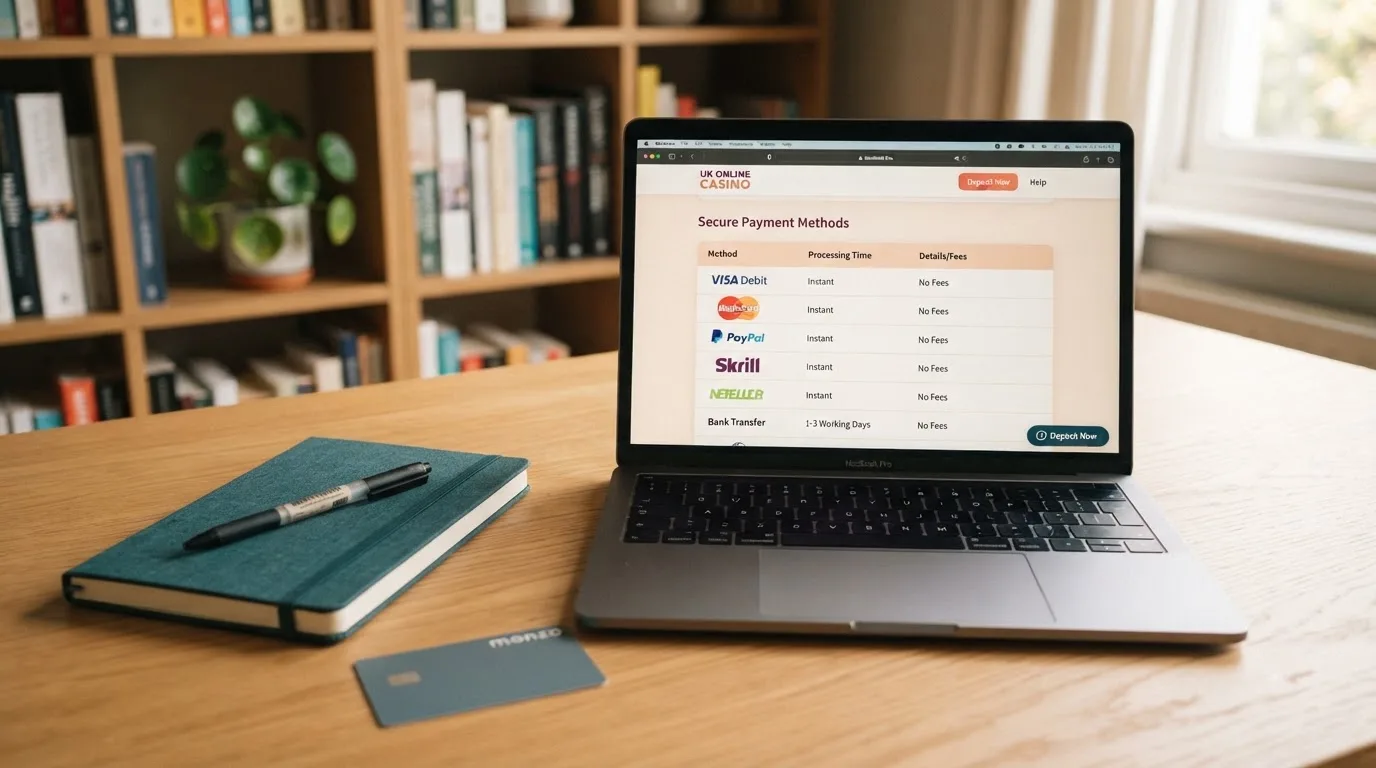
A phone screen at the deposit step shows several payment-method tiles, a card brand, an e-wallet, a bank logo, sometimes a pay-by-phone carrier. Each tile hides a contract. The debit card tile hides the credit-card ban and the card-issuer’s own gambling transaction policy. The e-wallet tile hides the wallet’s KYC requirements and the rule that an e-wallet funded from a credit card inherits that ban. The pay-by-phone tile hides a per-transaction ceiling and a different withdrawal route. The bank-transfer tile hides the Faster Payments Service and a settlement window that is usually seconds but occasionally two hours.
What the icons do not show is the part of the deal that matters: every one of these methods sits inside a Gambling Commission licence, and the licence obliges the operator to verify identity before the first deposit clears. That verification has been in force since 7 May 2019 and runs whichever method the customer chooses. The icon is a marketing choice; the verification is a regulatory one, and the two arrive at different points in the journey.
The image captures the moment the reader is most likely to choose on feel — the visible speed, the brand recognition, the implied simplicity. The decision actually hinges on what comes after: whether the same method accepts a withdrawal, how long the operator holds the payout, and whether the same ID and source-of-funds check has already happened. A payment method chosen for speed on the way in often turns out to be the wrong one on the way out.
Fundamentals of UK Online Casino Payment Methods
The UK online casino market runs on a narrow shelf of payment rails. Debit cards — Visa Debit and Mastercard Debit — are the dominant route, accepted at every licensed brand on the register. Bank transfers over the Faster Payments Service, launched in 2008 and operated by Pay.UK, are universal on the way in and most licensed operators support them on the way out. E-wallets sit in the middle: PayPal is widely accepted at GB-licensed brands because PayPal’s own UK policy requires it for licensed operators, while Skrill and Neteller are present on a smaller share. Apple Pay, developed and operated by Apple Inc. and supporting UK-issued cards from 14 July 2015, is a debit-card front-end rather than a wallet in its own right — the underlying card is still the funding source. Google Pay plays a similar role on Android. Pay-by-phone options, primarily carrier billing through services like Payforit, are deposit-only and capped low per transaction; withdrawals have to go back through a different method.
AstroPay, founded in 2009 and headquartered in Uruguay, sits at the edge of this list. Its UK entity, Larstal Limited, is an electronic money institution authorised by the Financial Conduct Authority under the Electronic Money Regulations 2011, so it is regulated on the money side, but acceptance at UK-licensed online casinos is uneven. The wider AstroPay group also runs entities in the Isle of Man (licensed by the Isle of Man Financial Services Authority for money transmission), Brazil (authorised by the Brazilian Central Bank as an electronic currency issuer) and Denmark (authorised as an electronic money institution by the Danish Financial Supervisory Authority). For the GB-licensed casino, what matters is the FCA authorisation of Larstal Limited; the rest is the wallet’s international footprint.
The credit-card question needs its own paragraph because it is the most common reason a reader ends up on this page. From 14 April 2020 the Gambling Commission banned the use of credit cards to fund gambling across all online and offline gambling products in Great Britain, with the narrow exception of non-remote lotteries paid face-to-face. Debit-card deposits were not affected. The ban covers credit cards routed through e-wallets as well, so funding a PayPal or Skrill account from a credit card and then gambling from the wallet is not a workaround. The Commission estimated that around 800,000 UK consumers used credit cards to gamble in 2018 and found that 22 per cent of online gamblers who used credit cards were classed as problem gamblers — the figure behind the rule.
The credit-card ban has a consequence the marketing copy rarely mentions. It narrows the deposit options at the table to funding sources where the customer cannot borrow: a current account, savings, an e-wallet already funded from those, or a phone bill. A pay-by-phone deposit is the closest analogue to credit because the carrier is extending short-term credit on the phone bill, and that is exactly why pay-by-phone deposits carry a low per-transaction ceiling and never extend to withdrawals. The structure of the ban pushes every method back toward money the player already has.
A consequence the reader rarely thinks about in advance: the same e-wallet may be accepted at the cashier on a Monday and declined on a Friday because the wallet’s own UK policy has changed. E-wallet acceptance at GB-licensed casinos is not a static contract. PayPal, for example, requires operators to hold a GB licence before it processes gambling transactions, which is why the GB-licensed set is largely the same set PayPal supports. Skrill and Neteller run their own acceptance tests on top of that. The reader checking this page in 2026 may find a method that worked last year is no longer offered, and the reason is at the wallet rather than at the casino.
How Long Withdrawals Actually Take Once Verification Is Done
Settlement speed is the most common reason a payment method is praised or damned in player reviews, and it is also the most over-claimed. A licensed operator cannot release a withdrawal before the customer’s identity, address and date of birth have been verified, before the customer has cleared GAMSTOP, before any source-of-funds checks the operator chooses to run are satisfied, and before any internal anti-money-laundering review is closed. Once those gates have passed, the operator’s own processing time applies, and only then does the payment method’s settlement speed matter.
On a method-by-method basis: bank transfers via the Faster Payments Service move 24 hours a day, seven days a week, and most arrive instantly or within a couple of minutes, though transfers can occasionally take up to two hours. The Faster Payments scheme sets a £1,000,000 per-transaction limit, though individual banks can and do impose lower limits on their customers. The Bank of England oversees the system’s safety and stability and provides final settlement, though it is not a direct participant in the scheme. A casino withdrawal sent by Faster Payments therefore arrives fast in principle, but only once the operator has released it; the page separates those two facts because readers conflate them.
Debit-card withdrawals run through the card schemes rather than Faster Payments. Visa Debit and Mastercard Debit withdrawals are usually credited within one to three working days once the operator has approved the payout, longer over a weekend. The card network does not guarantee instant settlement; the operator chooses when to send, the card scheme chooses how quickly the customer’s bank credits the account.
E-wallet withdrawals are typically the fastest on the operator side because the wallet can hold a balance, but the wallet’s own verification rules apply. A PayPal withdrawal to a PayPal account that has not been verified will sit pending at PayPal rather than at the casino. Skrill and Neteller behave similarly. Apple Pay and Google Pay are deposit-front-ends over the underlying card and do not change the withdrawal route — a withdrawal still goes back to the debit card. Pay-by-phone deposits cannot be withdrawn by the same method; the operator pays the withdrawal to a bank account, debit card, or e-wallet that has been separately verified.
A second-order point: the verification work is not a one-off. Financial vulnerability checks have run at £150 net deposits in a rolling 30-day window since 28 February 2025, using public data only, and a player who crosses that threshold mid-month will face a check before the next deposit clears. The check is fast in practice but it is a real interruption, and it can hold a withdrawal as well as a deposit. A reader whose monthly spend is variable should expect that.
The Licence: What the Gambling Commission Actually Requires of an Operator
A GB remote casino operating licence is not a marketing badge. It is an operating permission with conditions attached, and the conditions are the reason a brand on the register behaves differently from one that is not. The page summarises the conditions a reader cares about, not the full Licence Conditions and Codes of Practice (LCCP), because the LCCP runs to hundreds of pages and the reader’s question is narrower.
The licensing framework sits on the Gambling Act 2005, which covers Great Britain — England, Scotland and Wales — and not Northern Ireland. Since the Gambling (Licensing and Advertising) Act 2014 any operator taking customers in Great Britain needs a Commission licence wherever it is based. A Curaçao, Maltese or Gibraltar licence is not a substitute, and an operator carrying only an offshore licence while targeting UK customers is committing an offence under section 33 of the Gambling Act 2005. The Commission disrupts illegal sites through cease-and-desist notices, search-engine delisting and payment and hosting referrals, but it has no ISP-blocking power and no penalty aimed at the player.
The minimum age is 18, and name, address and date of birth must be verified before the first deposit or any play. Since 7 May 2019 that verification has been a precondition of play at every licensed operator, not a courtesy check after the first withdrawal request. The verification uses a combination of document checks, database lookups and, where needed, source-of-funds questions. Anonymous play is not possible at a licensed site.
The game-cycle stake limit came in two tranches: £5 for players aged 25 and over from 9 April 2025, and £2 for 18-24-year-olds from 21 May 2025. Auto-play has been banned since 31 October 2021, a slot spin may not be faster than 2.5 seconds, and losses disguised as wins are banned. The rules apply to every slot a licensed operator exposes to GB customers, regardless of where the game is produced.
The deposit-limit regime that took effect from 31 October 2025 obliges operators to prompt a customer to set a financial limit before the first deposit. The limit is player-set, not operator-set, and there is no state-set deposit or loss ceiling; the regulator’s position is that the player should choose the limit and the operator should record it. A reader who skips the prompt at sign-up has, in practice, agreed to a default the operator chooses, and revisiting it later is a setting change rather than a fresh prompt.
The bonus regime that took effect from 19 December 2025 caps wagering requirements at 10x and bans mixed-product bonuses, where a stake on one product returns a bonus in another (a sports bet that returns casino spins, for instance). The 10x cap is the figure that drives the calculation in the next section. The page treats the cap as a ceiling, not a floor: the average market requirement sits well below 10x, and a brand sitting at the cap is not offering a competitive deal.
The Jurisdicti Picture: Reading the Licence Certificate
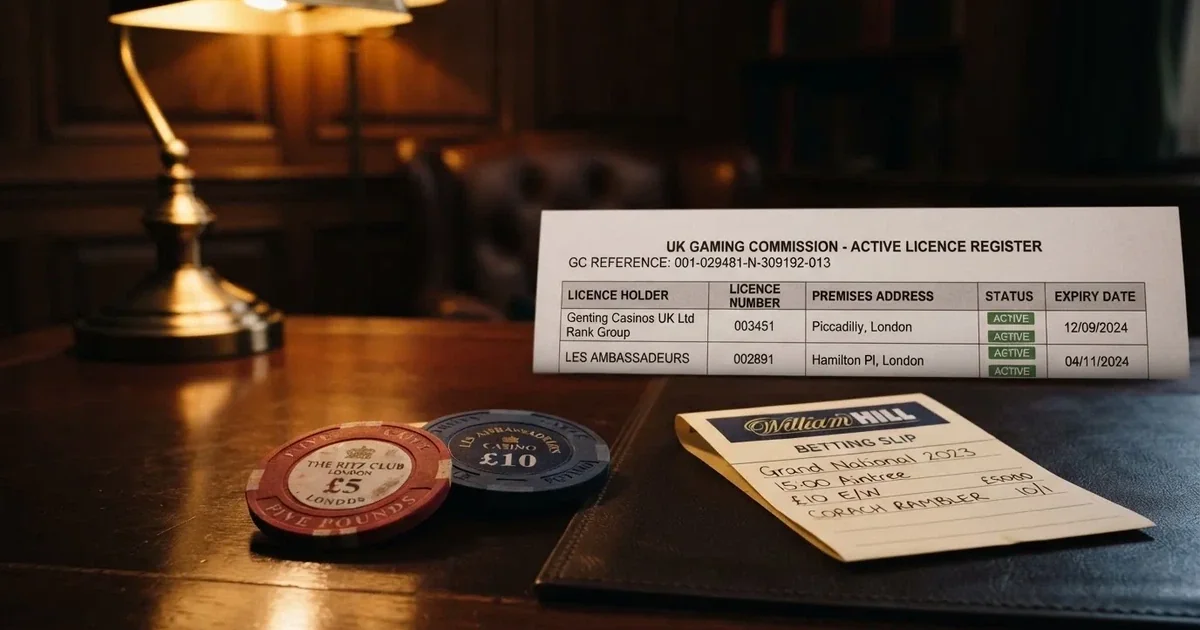
The certificate should be findable on the operator’s website footer or its “About” page, and the account and licence numbers on it should resolve against the public register when searched directly. If they do not, the certificate is the marketing prop. A useful certificate carries the operator’s legal name, the Gambling Commission account number, the full remote casino operating licence number in the account-R-number-suffix form, and the date the licence was issued or last renewed.

The Commission’s register holds 139 businesses with an active remote casino operating licence on 18 September 2026 — the figure the page opens with — and the certificate the reader is reading should resolve to one of them. A certificate that names a holding company but not the Commission’s account number is missing the only identifier the regulator uses. A certificate that quotes the operator’s own “licence number” rather than the Commission’s is signalling that the customer should look elsewhere.
The UK map faintly visible in the background of the certificate is not decorative. The Gambling Act 2005 covers Great Britain — England, Scotland and Wales — and not Northern Ireland. A brand licensed by the Commission is licensed for GB customers. A Northern Ireland customer sits outside the regime and should not be treated by the operator as a GB customer. The reader who lives in Northern Ireland and is reading this page from there has a different relationship with every brand on the table, and that is its own conversation.
Responsible Gambling Around Payment Methods
The safer-gambling regime that wraps payment methods at a licensed operator is what makes the choice between methods matter at all. Without it, “best payment method” would mean “fastest and cheapest”, and that is not what the page is for. The regime is built from three pieces, and the payment method is the surface they all act on.
GAMSTOP is the national online self-exclusion scheme, and it is a mandatory condition of every online licence since 31 March 2020. A player who registers with GAMSTOP excludes themselves from every GB-licensed online operator for six months, one year or five years, and the period cannot be cancelled early. Payment methods are how a self-excluded player would otherwise circumvent the exclusion, which is why the scheme sits at the operator level rather than at the payment-method level: the operator is the gate, not the wallet. A payment method that bypasses GAMSTOP is, by definition, an unlicensed route.
The financial vulnerability check that has run since 28 February 2025 at £150 net deposits in a rolling 30-day window is the lighter of the two checks the operator is expected to run. It uses public data only and is a flag for a conversation rather than a block. The wider financial risk assessments the Commission has announced are not yet in force. A reader whose deposits cross £150 in a 30-day window should expect a check, and a reader whose deposits run much higher should expect more intrusive questions about source of funds.
The player-set deposit limit that took effect on 31 October 2025 is the third piece. The operator must prompt for the limit before the first deposit; the player chooses the figure; the operator records it. The payment method is the route the limit sits on, and choosing a payment method that the limit applies to is what makes the limit real. A player who sets a low limit and then funds from a method that has not been registered against that limit has set the limit against nothing.
A consequence worth naming. The GamCare National Gambling Helpline and GambleAware sit beside GAMSTOP rather than behind it, and they are reachable regardless of payment method. The Commission’s complaints route is also available to every GB-licensed customer. The protections work because they run at the operator, not because the payment method is well chosen. The reader who picks a brand off this page and pays through any of the methods listed above gets the full set; the reader who picks an unlicensed brand off a search result and pays through the same method gets none of it.
What Actually Happens at the Deposit Button
The sequence at the deposit button is the same at every licensed operator and the same whichever method the customer chooses, which is the consequence the page’s angle is built on. The deposit attempt runs an identity check against the operator’s own records and against the Commission’s database. The deposit is then checked against GAMSTOP. The deposit is checked against the customer’s own deposit limit. The deposit is checked against any affordability or vulnerability flag the operator has on file. The payment method is asked to take the money. None of those steps is optional, and the order is fixed by the licence rather than by the brand.
The sequence at the withdrawal button is the same in reverse. The withdrawal request triggers a source-of-funds check if the operator has not already cleared one. The request is checked against the customer’s deposit history to ensure the withdrawal is sent to a method that has actually been used to deposit. The operator then releases the funds to that method. The method settles at its own speed. The same gates that protect the player on the way in protect them on the way out, and the page’s job is to keep that visible.
A consequence of the order: a payment method chosen on deposit day is, in most cases, the payment method the withdrawal will arrive on. The Commission’s rules allow the operator to send a withdrawal to a different method in narrow circumstances, but the default is the deposit method. A reader who deposits by debit card and then asks for the payout to PayPal is asking the operator to do extra work, and the operator is allowed to refuse. Choosing a method for its deposit convenience and a different one for its withdrawal speed is a plan that runs into this rule.
The Calculation: What a 10x Wagering Cap Means in Real Play
The bonus regime that took effect from 19 December 2025 caps wagering requirements at 10x. The cap is a ceiling, not a typical figure — most GB-licensed operators sit well below it, and a brand quoting 10x is at the edge of what the licence permits rather than at the market average. The arithmetic the cap forces on a player is the calculation the page is here to do.
Assume a bonus of £100 with a 10x wagering requirement, the maximum the cap permits. The required turnover is £100 × 10 = £1,000 — the amount the player must stake before any bonus-derived winnings become withdrawable. At a stake of £1 per spin, that turnover works out at 1,000 spins. The Gambling Commission’s slot rules also apply: a slot spin may not be faster than 2.5 seconds, so 1,000 spins at that floor is 2,500 seconds of play, or roughly 42 minutes of continuous play. At the £2 stake-per-spin floor for an 18-24-year-old player the spins halve to 500 and the time falls to about 21 minutes. At the £5 stake-per-spin ceiling for a 25-and-over player the spins drop to 200 and the time falls to about eight minutes.
That is the band. The arithmetic produces a range rather than a single figure because the stake-per-spin figure depends on the player’s age and on the slot they choose, and the wagering requirement depends on the operator’s offer. A player who is 30 and plays a slot at £5 per spin with a £100 bonus at the 10x cap is looking at roughly 200 spins and about eight minutes of play. A player who is 21 and plays the same slot at £2 per spin is looking at 500 spins and about 21 minutes. A player who is 30 and plays a low-stake slot at £0.10 per spin is looking at 10,000 spins and over four hours of play, and is well past the time a player usually spends on a single bonus. The band is wide because the inputs are wide; the calculation does not flatten them.
The arithmetic is a statistical estimate, not a guaranteed outcome. The house edge on a slot at the operator’s published RTP is the figure that decides what the bonus actually costs in real money, and that figure is independent of the wagering requirement. The 10x cap is a usability rule, not a generosity rule, and a brand sitting at the cap is not necessarily cheaper than one sitting at 5x if the underlying RTP is lower. The page reports the band the formula produces and stops there.
A consequence. A player reading a marketing offer that says “£100 bonus, 10x wagering” is being offered the worst-case scenario the licence permits. The number to ask the operator is the actual RTP of the slot the bonus is restricted to, because the RTP is what decides the cost of clearing the turnover. Two brands offering “£100 bonus, 10x wagering” can sit at very different real costs.
The Operators in Detail
The ten brands above are reviewed below in the order the Commission’s register records them, with a verdict that comes from the page’s own reading of the licence record rather than from any single marketing claim. A reader who only reads the verdicts has the page’s view; a reader who reads the full write-ups has the reasoning behind it.
Virgin Games — A White-Label Brand on a Shared Licence
Virgin Games operates as a white-label site under Gamesys Operations Limited (account 38905), which holds the remote casino licence 038905-R-319430-022. As a white-label, the site runs under another company’s licence. Jackpotjoy, also on this list, shares the same licence; both brands use the same compliance file, customer service, and complaints process.
Virgin Games carries the standard GB-licensed protections: GAMSTOP enrolment, age and ID verification, the deposit-limit prompt, and the 10x wagering cap. Because it is a white-label brand, it relies on the operator’s established reputation.
The verdict: an operator included for its licensed status and consistent compliance posture. The shared-licence nature is the essential detail for readers.
Betfred — A Long-Established Bookmaker on the Register
Betfred represents an active domain under Petfre (Gibraltar) Limited (account 39544), possessing the remote casino licence 039544-R-319290-010. The licence holder operates from Gibraltar, a practice permitted by the Gambling (Licensing and Advertising) Act 2014, provided the operator holds a Commission licence for GB customers.
Betfred integrates its casino vertical with its sportsbook. All standard deposit, verification, and bonus rules apply here. Players with existing sportsbook accounts will find the casino services integrated under the same account and compliance verification.
The verdict: the inclusion is justified by the valid licence. Note that the casino and sportsbook share an account, meaning payment terms are consistent across the brand’s offerings.
Betfair — A Multi-Vertical Brand on a Single Licence
Betfair operates as an active domain via PPB Games Limited (account 39411), which holds the remote casino licence 039411-R-319335-010. PPB Games Limited is the licensed operator behind the casino product.
As with other multi-product operators, the casino falls under the same regulatory framework as the exchange and sportsbook. Verification, deposit limits, and bonus rules apply uniformly across the site. Returning customers do not need fresh identity checks to access the casino.
The verdict: included for its compliance standing; the casino product shares the platform’s overall regulatory posture. Regular users will experience the same payment behaviours as with the brand’s other products.
Sky Vegas — A Casino-Focused Brand on the Register
Sky Vegas is an active domain under Bonne Terre Gaming Limited (account 65519), which holds the remote casino licence 065519-R-339675-002. This entity focuses specifically on casino operations rather than the broader Sky media business.
Standard gambling protections—verification, deposit limits, and bonus caps—apply here. Customers familiar with Sky’s subscription services should understand that the casino maintains a distinct compliance and verification posture.
The verdict: the operator meets all licensing requirements, maintaining a casino-focused identity. Those seeking casino-specific payment experiences will find them supported, all within the mandated GB regulatory frame.
Gala Bingo — A Bingo-First Brand on the Register
Gala Bingo is an active domain under LC International Limited (account 54743), which holds the remote casino licence 054743-R-330863-014. LC International Limited also manages Ladbrokes and Coral, so these brands operate as part of a family.
While the product is bingo-focused, all core licensing obligations—verification, deposit limits, and the 10x wagering cap—remain in effect.
The verdict: the operator is fully licensed, with a product mix leaning toward bingo. Readers should note that it shares a licence with Ladbrokes and Coral, meaning they are part of the same corporate family.
32Red — A Casino-Focused Brand on the Register
32Red operates as an active domain under Platinum Gaming Limited (account 45322), holding the remote casino licence 045322-R-324275-019. Platinum Gaming Limited functions as the primary operator.
This is a dedicated casino platform, subject to all standard regulatory requirements including identity verification and bonus rules.
The verdict: the operator maintains a valid licence, and its platform structure is well-suited for a straightforward comparison. Its market tenure is context, but regulatory compliance is the sole benchmark.
Casumo — A Casino-Focused Brand on the Register
Casumo operates as an active domain under Recro Limited (account 61549), possessing the remote casino licence 061549-R-336718-002.
As a dedicated casino operator, Casumo adheres to all GB licensing requirements regarding verification, deposit limits, and bonus caps. Customers moving between licensed sites will find a familiar regulatory environment.
The verdict: fully licensed and focused on the casino market. For those prioritizing a regulated operator with transparent licensing, it fits the standard requirements.
Midnite — A Newer Brand on the Register
Midnite operates as an active domain under Dribble Media Limited (account 42647), holding the remote casino licence 042647-R-321653-022.
The site is a more recent addition to the licensed landscape. It complies with all mandatory protocols, including identity verification, deposit limits, and the 10x wagering cap.
The verdict: the operator is fully licensed, providing a modern entry point for players. While the licence holder’s history is shorter than some peers, the regulatory status is current and valid.
PokerStars — A Poker-First Brand on the Register
PokerStars functions as an active domain under Stars Interactive Limited (account 39108), holding the remote casino licence 039108-R-319334-026. The operator manages both poker and casino verticals under this account.
The regulatory framework—including mandatory verification and financial safety measures—applies uniformly across its product range. Users familiar with its poker offerings will find identical compliance standards at the casino.
The verdict: included for its valid licensing. While poker-focused, the casino product operates under the same robust regulatory framework as the brand’s other offerings.
Jackpotjoy — A Shared-Licence Brand on the Register
Jackpotjoy is an active domain managed by Gamesys Operations Limited (account 38905), holding the remote casino licence 038905-R-319430-022. This account is shared with Virgin Games, meaning the operations are integrated.
Both brands maintain a unified approach to deposits, verification, and bonuses. A player registered at one site effectively uses the same system as the other.
The verdict: included for its regulatory compliance, with the caveat that it shares an operator and compliance posture with Virgin Games. The shared licence is the relevant detail for those comparing brands.
What the Reader Should Take From the Comparison
The ten brands above are on the same licence-driven playing field. Every one of them verifies identity before the first deposit, runs GAMSTOP, applies the deposit-limit prompt of 31 October 2025, applies the 10x wagering cap of 19 December 2025, and routes payments through the same set of rails (debit cards, Faster Payments bank transfers, the e-wallets that have agreed to work with GB-licensed operators, Apple Pay and Google Pay as debit-card front-ends, and pay-by-phone as a deposit-only option).
The differences between them are at the product level rather than the licence level. A casino-only brand behaves differently from a sportsbook-plus-casino brand because of the verticals it carries, not because of the licence it holds. A bingo-led brand behaves differently from a casino-led brand for the same reason. A white-label brand and a brand on its own licence behave the same at the player level; the structural difference is for the reader who wants to know which operator is actually behind the brand.
The payment-method angle that runs through this page is narrower than the marketing suggests. The best payment method at a GB-licensed casino is the method the player already has and can verify, because every method runs through the same verification and the same deposit-limit regime. The marketing implication is that “fastest withdrawal” is a consequence of the operator’s processing speed rather than the wallet’s, and that the choice between e-wallet and bank transfer is a choice about convenience rather than speed at a GB-licensed brand.
A consequence the page names last because it is the one that catches readers out: the protections on this page — GAMSTOP, the deposit limit, the verification, the ADR route — apply because the operator is licensed, not because the payment method is well chosen. The same payment method at an unlicensed brand has none of those protections. The choice that matters most is the choice of operator, and the register is how that choice is made visible.
Closing Notes on the Frame
The data the page is built on is a snapshot. The Gambling Commission’s public register is updated continuously, and the licence numbers, domain statuses and account totals above reflect the register as it stood on 18 September 2026. A reader who re-runs the same search will find the same brands in the same status, with the occasional addition or removal that the Commission processes in its normal cycle. The remote casino operating licence is the relevant licence for online casino; other licence types on the register (betting, bingo, lottery) sit alongside it but are not the licence a GB-licensed casino runs on.
The 10x wagering cap of 19 December 2025 and the deposit-limit prompt of 31 October 2025 are the two bonus and safer-gambling rules that bind a GB-licensed casino in 2026. The game-cycle stake limits — £5 for 25-and-over from 9 April 2025 and £2 for 18-24 from 21 May 2025 — apply to every slot the casino exposes. The verification rule of 7 May 2019 applies before the first deposit. The credit-card ban of 14 April 2020 applies to every payment method, including e-wallets funded from credit. The financial vulnerability check of 28 February 2025 applies at £150 net deposits in a rolling 30 days. These dates are the spine of the page; the figures above are the rules they bind.
The page closes where it opened. The register is the frame, the licence is the test, and the payment method is the surface the licence acts on. A reader who has read this far should be able to take any brand from the table, check its licence number against the public register, and confirm what the table says. A reader who cannot do that has not been told what the page is for.
Frequently Asked Questions About UK Online Casino Payment Methods
Are credit cards still allowed for UK online casino deposits?
No. From 14 April 2020 the Gambling Commission banned the use of credit cards to fund gambling across all online and offline gambling products in Great Britain, except for non-remote lotteries paid face-to-face. Debit cards and bank transfers were unaffected, and the ban covers credit cards routed through e-wallets as well as direct credit-card deposits. A licensed operator will decline a credit card at the cashier.
Which casino payment methods are generally considered safest?
The “safest” frame in this market is the operator, not the wallet. A payment method at a GB-licensed operator sits inside the Commission’s safer-gambling regime, including GAMSTOP enrolment, age and ID verification before the first deposit, and the deposit-limit prompt from 31 October 2025. The same method at an unlicensed site carries none of those protections, and that is the practical difference between “safe” and “unsafe” in this context. Among the methods themselves, debit cards, bank transfers and PayPal (where accepted at a GB-licensed brand) are the most consistent across operators.
Does Paysafecard work as a deposit method at UK-licensed casinos?
Paysafecard is a prepaid voucher that can be used at the cashier of a GB-licensed casino where the operator accepts it. The voucher is deposit-only; withdrawals cannot be sent back to a Paysafecard because the voucher has no account attached to it. The Commission does not ban the use of Paysafecard for gambling, and the voucher sits outside the credit-card ban because it is prepaid rather than borrowed. Acceptance at a specific brand is the operator’s choice rather than a rule.
Do all casino payment methods settle withdrawals at the same speed?
No. Once the operator has approved a payout, Faster Payments bank transfers typically arrive within seconds or minutes, debit-card withdrawals usually credit within one to three working days, and e-wallet withdrawals sit at the wallet’s own processing speed — fast on the wallet’s side once the operator has released the funds, slower where the wallet’s own verification is incomplete. Pay-by-phone deposits cannot be withdrawn by the same method; the operator pays the withdrawal to a bank account, debit card or e-wallet that has been separately verified.
Is ID verification required before a first deposit regardless of payment method?
Yes. Since 7 May 2019 every GB-licensed online casino has been required to verify name, address and date of birth before the first deposit or any play. The verification is not optional, and a deposit attempt that fails the verification will not clear regardless of the payment method chosen. Anonymous play is not possible at a licensed site, and the verification work has to happen before any stake is placed.
Can a withdrawal be sent back to a different payment method to the one used for deposit?
In most cases, no. The Commission’s rules allow the operator to send a withdrawal to a different method in narrow circumstances, but the default is the method that was used to deposit. An operator is permitted to refuse a withdrawal to a different method, and a player who deposits by debit card and asks for the payout to PayPal is asking the operator to do extra work that the licence does not require. Choosing the deposit method with the withdrawal route in mind is the practical move.
Published by the casinoratingsuk team.