
Paying by Phone Credit at UK Mobile Casinos: What a Deposit Actually Involves
 Available in GB
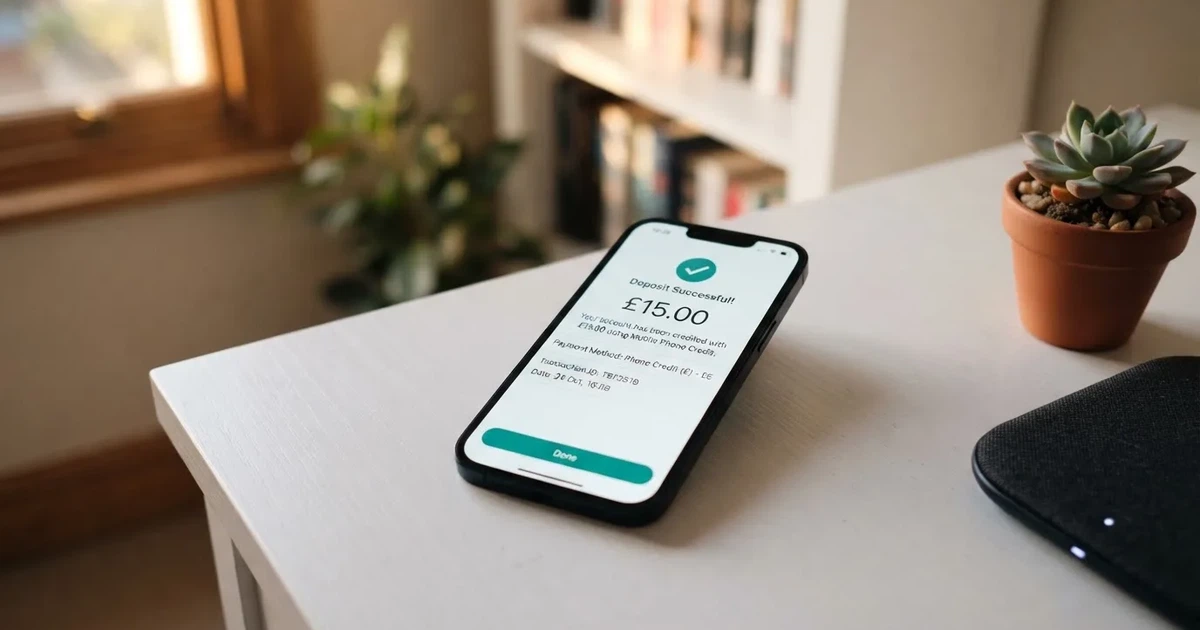
Paying by phone credit at a UK mobile casino means charging a deposit to a mobile phone bill or pay-as-you-go credit through a carrier-billing scheme, then playing at a site the Gambling Commission has licensed. The deposit reaches the casino account fast, the per-transaction ceiling is low, and the licence number on the register is the single test of whether a site is allowed to take that deposit at all.
Data current as of 23 September 2026 and verified against the Gambling Commission’s public register of gambling businesses.
Table of Contents
- How a phone-credit deposit reaches a casino account
- UK licensing: what a Commission licence obliges a casino to do
- Safer gambling around a phone-credit deposit
- How fast a deposit clears, and how fast a withdrawal follows
- UK-licensed casinos reviewed for phone-credit deposits
- The comparison table
- What the 10x wagering cap actually means for a bonus
- How the wagering cap intersects with phone-credit deposits
- Where phone-credit deposits fit a player’s habits
- What this comparison does not cover
- Frequently Asked Questions
How a phone-credit deposit reaches a casino account
A pay-by-phone-credit deposit is a carrier-billing transaction. The player enters a deposit amount at the casino cashier, confirms the request through the mobile network (usually by SMS or a carrier redirect), and the charge lands on the monthly phone bill or, for pay-as-you-go customers, against available top-up credit. The casino receives the funds through a payment processor that mediates between the operator and the mobile carrier — Payforit being the long-standing UK scheme for this route, with Boku as the most prominent international processor operating in the same space.

Payforit grew out of the SimPay consortium work that began in 2005 and launched in 2007. Boku, headquartered in London, was founded in 2009 and now operates across more than 90 countries, billing transactions directly to a customer’s mobile phone account. The mechanics at the cashier are the same whichever processor sits behind the curtain: a small deposit amount, an SMS confirmation on the player’s mobile, and the funds appearing in the casino balance within seconds. Withdrawals do not run the same way — a phone-credit deposit cannot be reversed back onto the phone bill, so the operator pays the withdrawal through a bank transfer, debit card or e-wallet.
The distinction matters because it sets the ceiling on what phone-credit deposits are for. They are a small-ticket funding route, not a general payment method. The UK premium-rate framework that governs the underlying phone-paid services — including the service-charge cap between 7p per minute on 084x numbers and £3.60 per minute on 09xx numbers — applies to call-based services rather than to SMS-billed gambling deposits, but it shows the regulator’s wider posture toward spend that runs through a phone number.
The carrier-billing layer and what sits behind it
The casino cashier rarely shows the processor by name. Payforit and Boku both work through the same carrier APIs, and the player’s confirmation step — an SMS PIN or a one-tap carrier confirmation page — is what actually authorises the charge. Boku states it supports more than 200 local payment methods through a single API across more than 40 markets, with carrier billing as one of them. For the player, the practical effect is that a £10 deposit at a licensed site looks identical regardless of which processor the operator has integrated.

Apple Pay, Google Pay and the adjacent routes
Phone-credit deposits are distinct from wallet-based mobile payments. Apple Pay, launched in October 2014 and supporting UK cards from July 2015, tokenises card data and authenticates each transaction through Face ID or Touch ID — a card sits behind the wallet, not a phone bill. Google Pay works on a similar principle. Both are available at many UK-licensed casinos and both clear deposits in seconds, but neither qualifies as a phone-credit deposit for the purposes of this comparison. They are card-funded mobile payments; a pay-by-phone-credit deposit is carrier-funded.
AstroPay and the e-wallet tier
AstroPay, founded in 2009 and headquartered in Uruguay, is a separate case again: a digital wallet offering online payments, virtual and physical debit cards, and peer-to-peer transfers, with its UK entity (Larstal Limited) authorised by the Financial Conduct Authority as an electronic money institution. Some UK-licensed casinos list AstroPay in their cashier; it is wallet-funded rather than carrier-funded, so a deposit routed through AstroPay is not a phone-credit deposit either.
UK licensing: what a Commission licence obliges a casino to do
Every operator taking customers in Great Britain needs a Gambling Commission licence under the Gambling Act 2005, with the obligation widened to any operator wherever it is based by the Gambling (Licensing and Advertising) Act 2014. A Curaçao, Maltese or Gibraltar licence is not a substitute. The Commission’s public register is the test: on 18 September 2026 it listed 139 businesses holding an active remote casino operating licence, with 1,065 active and 361 white-label domain entries — a white-label site trades under another company’s licence and inherits its conditions.
A remote casino licence number on the register takes the form account-R-number-suffix, where the leading six digits repeat the licence holder’s account number and the R marks a remote (online) licence. bet365, for instance, sits under account 55149, Hillside (UK Gaming) ENC, with the active licence 055149-R-331499-004. The number is not a marketing badge — it is the reference a player can quote to the Commission if something goes wrong.
The licence binds the operator to a set of conduct rules known as the LCCP, the social responsibility code, and the Remote Technical Standards. The conditions that touch a phone-credit deposit directly are: minimum age 18 with name, address and date of birth verified before the first deposit or any play (since 7 May 2019); mandatory participation in GAMSTOP, the national online self-exclusion scheme (since 31 March 2020); and the credit-card ban that took effect on 14 April 2020 — credit cards are not allowed for gambling, including credit cards routed through e-wallets. A pay-by-phone-credit deposit is not a credit card and is not caught by that ban; it is a carrier-billed charge against the phone account.
The limits every licensed site has to enforce
Three limits shape what a player actually experiences at a licensed site. Online slots carry a maximum stake per game cycle: £5 for players aged 25 and over (from 9 April 2025) and £2 for 18-24-year-olds (from 21 May 2025). Auto-play has been banned since 31 October 2021, and a slot spin may not complete in fewer than 2.5 seconds; losses disguised as wins are also banned. There is no state-set deposit or loss ceiling, but operators must prompt a customer to set a financial limit before the first deposit, with the rule in force from 31 October 2025.
Bonus terms have their own ceiling. Since 19 December 2025 wagering requirements are capped at 10x, and mixed-product bonuses — a sports bet that unlocks casino spins, for instance — are banned. Anonymous play is not possible at a licensed site: identity verification runs before the first deposit, and the financial vulnerability checks that began on 28 February 2025 trigger at £150 of net deposits in a rolling 30-day window.
Safer gambling around a phone-credit deposit
Phone-credit deposits sit at the intersection of two controls: the carrier’s own spend caps and the operator’s safer-gambling tools. Both apply. The carrier side imposes a per-transaction ceiling — typically £10 or £30, depending on the network — which means the deposit limit a player can enforce through the phone is naturally low. The operator side adds the mandatory prompt for a financial limit before the first deposit, GAMSTOP enrolment for anyone who has self-excluded, and the financial vulnerability check that escalates at £150 in a rolling 30 days.
GAMSTOP is the most consequential of these for a player who has decided to stop. The scheme runs periods of six months, one year or five years, and the registration cannot be cancelled early. Every online operating licence issued by the Commission is conditional on the operator’s participation, so a licensed site will refuse to open an account — or close an existing one — for anyone whose name is on the GAMSTOP database. The national Gambling Helpline (GamCare) and GambleAware provide the support routes around the self-exclusion decision.
The offshore caveat belongs here, stated once. A site licensed in Curaçao or Malta but accepting UK customers without a Commission licence is operating illegally under section 33 of the Gambling Act 2005, and the Commission disrupts illegal sites through cease-and-desist notices, search-engine delisting referrals and payment and hosting referrals — but the Commission has no ISP-blocking power, so unlicensed sites remain reachable. No penalty falls on the player; what the player loses on an unlicensed site is protection — no GAMSTOP, no Commission complaints route, no approved ADR.
How fast a deposit clears, and how fast a withdrawal follows
A phone-credit deposit reaches a casino account in seconds. The cashier request triggers an SMS confirmation or a carrier redirect, the player approves, and the funds appear in the balance immediately. There is no bank clearing time to wait through because the charge sits on the phone account rather than moving through card rails. This is the part of the experience the method is chosen for.
A withdrawal runs the other way and is slower. A player cannot withdraw back to a phone bill — that direction does not exist in carrier billing. The operator pays the withdrawal through whatever method the player selected at the cashout step: a bank transfer, a debit card, or an e-wallet. Once ID and source-of-funds checks are complete, settlement times depend on the rails chosen and the operator’s own processing queue, not on the deposit method that originally funded the account. The deposit choice does not dictate the withdrawal choice.
Identity verification is the gate that has to open before any withdrawal at a licensed site. Name, address and date of birth are verified before the first deposit; the financial vulnerability check that runs at £150 of net deposits in a rolling 30 days can prompt a source-of-funds review. A player who completes verification at deposit time usually sees withdrawals processed faster than one who postpones it.
UK-licensed casinos reviewed for phone-credit deposits
Ten operators from the Commission’s public register are reviewed below. Every one holds an active remote casino operating licence and is therefore bound by the LCCP, GAMSTOP participation and the verification rules. None of the entries below carries a bonus offer: the register entry is the test, and the wagering-requirements cap in force since 19 December 2025 applies to any bonus the operator does publish on its own site. The order follows the register; this is not a ranking.
bet365
bet365 sits under Hillside (UK Gaming) ENC (account 55149), with the active remote casino operating licence 055149-R-331499-004 and Bet365.com listed as an active domain. Subject support: no-data — the Commission’s public register does not record payment methods at domain level, so whether the cashier lists a phone-credit route is a question the operator’s own deposit page answers. The licence is one of the larger by account number, and the LCCP conditions apply in full. For a player who wants a major UK-licensed brand and is content to confirm the deposit route at the cashier, bet365 is part of the shortlist.
Betfred
Betfred sits under Petfre (Gibraltar) Limited (account 39544), with licence 039544-R-319290-010 and Betfred.com listed as an active domain. The Gibraltar incorporation does not change the regulatory position: the Gambling (Licensing and Advertising) Act 2014 brings every operator taking GB customers under the Commission regardless of where it is based, so Betfred is bound by the LCCP and GAMSTOP like any other Commission licensee. Subject support: no-data at register level. The brand carries a high-street identity that translates into recognisability rather than into a registered deposit-method list.
PokerStars
PokerStars sits under Stars Interactive Limited (account 39108), with licence 039108-R-319334-026 and Pokerstars.uk listed as an active domain. The .uk domain is the one to verify against the register; a .com variant is a different entity. Subject support: no-data. PokerStars’ poker heritage is the brand’s distinguishing feature; the casino cashier is a separate product line under the same licence and the same obligations.
32Red
32Red sits under Platinum Gaming Limited (account 45322), with licence 045322-R-324275-019 and 32red listed as an active domain. Subject support: no-data. The smaller account number relative to the larger operators reflects a more focused operation; the licence is unrestricted on the remote casino side. For a player who prefers a casino-only brand over a sportsbook-with-casino brand, 32Red fits that profile without changing the regulatory standing.
Virgin Games
Virgin Games is listed on the register as a white-label domain of account 38905, Gamesys Operations Limited, which holds licence 038905-R-319430-022. White-label means Virgin Games trades under Gamesys Operations Limited’s licence rather than holding its own — a structural point the register makes explicit. Subject support: no-data. A white-label listing is not a lesser licence; the conditions the player experiences at the cashier are Gamesys Operations Limited’s LCCP obligations, enforced through the same Commission route.
William Hill
William Hill sits under WHG (International) Limited (account 39225), with licence 039225-R-319373-015 and William Hill listed as an active domain. The brand’s high-street history is the recognisable marker; the regulatory position is the same as every other Commission licensee on this list. Subject support: no-data. William Hill carries the largest offline footprint of any brand reviewed here, which can matter for a player who values being able to walk into a shop and discuss an account query in person.
Midnite
Midnite sits under Dribble Media Limited (account 42647), with licence 042647-R-321653-022 and Midnite.com listed as an active domain. Payment method details are not recorded on the register; visit the operator’s site to check the cashier. Midnite is the newest brand on this list by account number and operates as a digital-native casino rather than as an extension of a high-street chain. The licence is unrestricted on the remote casino side, and the LCCP conditions apply in full.
Grosvenor Casinos
Grosvenor Casinos sits under Rank Interactive (Gibraltar) Limited (account 57924), with licence 057924-R-334666-005 and Grosvenor Casinos listed as an active domain. The Rank Group’s land-based casino identity runs through the same corporate parent, so a player who has used a physical Grosvenor casino will find the same brand running the online product under a Commission licence. Subject support: no-data. The dual presence — physical and online — is the distinguishing feature; the online licence terms are the same as every other entry here.
888casino
888casino sits under 888 UK Limited (account 39028), with licence 039028-R-319297-014 and 888casino listed as an active domain. Payment method details are not recorded on the register; visit the operator’s site to check the cashier. 888 is one of the longer-established casino-only brands under Commission oversight, and the LCCP conditions are unchanged from any other entry on the list. The brand’s casino-only positioning is the profile marker; the licence number is the standing.
kwiff
kwiff sits under Eaton Gate Gaming Limited (account 44448), with licence 044448-R-323408-017 and Kwiff.com listed as an active domain. Payment method details are not recorded on the register; visit the operator’s site to check the cashier. kwiff is the second-newest brand on the list by account number and positions itself around rapid bet settlement; the casino product sits under the same licence. The Commission’s rules apply regardless of the brand’s product differentiator.
The comparison table
The register is the only column that is fully populated across all ten brands: every one holds an active remote casino operating licence, and the licence number is verifiable on the Commission’s public register. The domain-status column distinguishes active from white-label entries, with Virgin Games as the only white-label listing on the table. The subject-support column carries no-data for every entry, because the register does not record payment methods at domain level — that is an operator-by-operator check at the cashier, not a register-derived fact.
| Brand | Licence holder and GB remote casino licence | Domain status on the register | Subject support |
|---|---|---|---|
| bet365 | Hillside (UK Gaming) ENC · 055149-R-331499-004 | Active | — |
| Betfred | Petfre (Gibraltar) Limited · 039544-R-319290-010 | Active | — |
| PokerStars | Stars Interactive Limited · 039108-R-319334-026 | Active | — |
| 32Red | Platinum Gaming Limited · 045322-R-324275-019 | Active | — |
| Virgin Games | Gamesys Operations Limited · 038905-R-319430-022 | White Label | — |
| William Hill | WHG (International) Limited · 039225-R-319373-015 | Active | — |
| Midnite | Dribble Media Limited · 042647-R-321653-022 | Active | — |
| Grosvenor Casinos | Rank Interactive (Gibraltar) Limited · 057924-R-334666-005 | Active | — |
| 888casino | 888 UK Limited · 039028-R-319297-014 | Active | — |
| kwiff | Eaton Gate Gaming Limited · 044448-R-323408-017 | Active | — |
What the table cannot say is which cashier lists a phone-credit route. The register is silent on payment methods by design: it records who is licensed, not what each cashier accepts. A player comparing options across these ten brands needs to check each operator’s deposit page directly, because the Commission’s data does not answer that question and the operator-by-operator variation is real.
The structural split — one white-label entry, nine direct-licence entries — is the only register-level differentiator on this table. Both routes carry the same LCCP conditions, the same GAMSTOP participation, and the same Commission complaints route. White-label status is an organisational fact about how the brand is run, not a weaker form of licence.
What the 10x wagering cap actually means for a bonus
The wagering-requirements cap that took effect on 19 December 2025 limits how many times a bonus amount must be turned over before it can be withdrawn. Under the cap, a £100 bonus carries a turnover requirement of at most £1,000; a £50 bonus, at most £500. The cap also closes the mixed-product bonus route — a sports bet that unlocks casino spins, for instance, is no longer a permitted structure at a Commission-licensed site. A licensed casino cannot publish a bonus with a wagering multiple above 10x; it cannot combine bonus products across verticals in a single offer.
The cap binds the marketing claim, not the underlying house edge. A bonus with a 10x wagering requirement still has to be cleared against a game with a house edge, and the time it takes depends on the stake size and the spin interval. A £100 bonus with a 10x requirement at £1 per spin means £1,000 of wagering across 1,000 spins; at the 2.5-second minimum spin interval that is roughly 42 minutes of continuous play, and the expected loss over those 1,000 spins depends on the slot’s RTP — at a 96% RTP the expected loss is around £40, at a 94% RTP closer to £60.
The arithmetic shifts quickly. A £30 bonus at 10x wagering requires £300 of turnover at £1 per spin, or 300 spins, or about 12.5 minutes at the minimum interval. The expected loss at 96% RTP is around £12. These are statistical estimates over many spins under the stated assumptions, not guaranteed outcomes for any single player — the estimate assumes only the bonus amount is wagered, and a session that varies the stake or the title will move the result.
The band the cap creates is wider than any single figure. A small bonus cleared at a high-RTP slot costs the player less than a large bonus cleared at a low-RTP slot, and both are within the 10x ceiling. The cap stops one form of excess — a 40x or 60x requirement that effectively locks the bonus in — without removing the underlying expectation that clearing a bonus costs something.
How the wagering cap intersects with phone-credit deposits
The cap applies to the bonus, not to the deposit method. A phone-credit deposit is a funding route, and the wagering requirement is a bonus condition. They meet at the cashier, where a player depositing by phone credit may also be claiming a bonus — and that bonus is bound by the 10x ceiling regardless of how the deposit was funded.
This is the practical consequence of the change. Before 19 December 2025 a player could encounter bonuses with wagering requirements well above 10x at licensed sites; after that date the ceiling is uniform across the licensed market. A bonus advertised with a 30x or 50x wagering multiple is now a marker of an unlicensed site, and the section on the offshore caveat above spells out what an unlicensed site costs the player in lost protections.
The cap also sharpens the comparison between bonuses. With every licensed offer bound by the same 10x ceiling, the differentiator shifts to the bonus size, the eligible games, and the time window for clearing — not to the multiple. A player comparing offers at licensed sites reads the headline amount, the eligible game list, and the expiry terms; the multiple is fixed.
Where phone-credit deposits fit a player’s habits
The method suits small, frequent deposits at a licensed site. The per-transaction ceiling is set by the carrier rather than by the casino, typically in the £10-£30 range, which means a player who wants to deposit £200 in a session will need multiple transactions. Each clears in seconds, but the ceiling is the ceiling.
The method does not suit large deposits or withdrawals. A bank transfer or a debit-card deposit has a higher ceiling, and a withdrawal can only run through a bank transfer, a debit card or an e-wallet — not back to the phone bill. A player whose bankroll is £500 or more per session will likely find a card deposit more efficient, and a player who wants to withdraw winnings will do so through a separate channel regardless of how the deposit was funded.
The method suits a player who wants to keep gambling spend separate from a bank account. A pay-as-you-go customer charging deposits to phone credit spends against top-up credit rather than against a bank balance, which provides a natural ceiling. A monthly-bill customer sees the deposits roll into the phone bill alongside other charges, and the visibility that brings is part of what the carrier-billing layer is designed to provide.
What verification looks like at deposit time
The first deposit triggers full identity verification at a Commission-licensed site. Name, address and date of birth are checked against public data, and the verification usually completes within minutes for a player whose details match cleanly. A mismatch — a flat number that does not match the post-code record, a name with a recent change — adds a manual review step that can take 24-72 hours. Verification is a one-off: once complete, it does not run again at the same site unless the financial vulnerability check fires at the £150 net-deposits threshold in a rolling 30 days.
What a withdrawal looks like at the same site
A withdrawal request goes into the operator’s processing queue. Once ID and source-of-funds checks are clear, the operator releases the funds, and the receiving end determines the speed: an e-wallet can settle within hours, a debit card typically within one to three working days, a bank transfer within three to five. The deposit method does not determine the withdrawal speed; the withdrawal method does.
What this comparison does not cover
This page compares ten operators from the Commission’s public register on licensing standing and domain status. It does not compare RTPs, game libraries, customer-support response times, or active bonus terms — those vary week to week and sit outside the register-derived fact base. A player choosing between these ten brands on grounds other than licence standing needs current operator-level data, which the operator’s own site provides.
The page does not name which cashier lists a phone-credit route. The Commission’s register does not record payment methods at domain level, and the operator-by-operator variation is real. A player who has settled on a brand from this list should check that brand’s deposit page for the current payment-method list before assuming the route is available.
The page does not address credit-card deposits, which have been banned for gambling since 14 April 2020 including credit cards routed through e-wallets. A player whose funding route is a credit card will need to switch to a debit card, a bank transfer, an e-wallet, or a phone-credit deposit before playing at a licensed site.
Frequently Asked Questions
How does paying by phone credit work at a mobile casino?
A player enters a deposit amount at the cashier, confirms the request through the mobile network by SMS or carrier redirect, and the charge lands on the monthly phone bill or against pay-as-you-go credit. The casino receives the funds through a carrier-billing processor, typically Payforit or Boku, and the deposit appears in the balance within seconds. The deposit cannot exceed the carrier’s per-transaction ceiling.
Is a pay-by-phone-credit deposit added straight to a phone bill?
Yes, for a monthly-bill customer the charge appears on the next phone bill alongside other charges. For a pay-as-you-go customer the charge reduces available top-up credit. In both cases the casino balance updates immediately on confirmation; the bill or credit adjustment follows the carrier’s normal cycle.
Do UK-licensed casinos still run ID checks before a phone-credit deposit?
Yes. Name, address and date of birth are verified before the first deposit or any play, a condition in force since 7 May 2019. The check runs at deposit time regardless of the funding route. A player whose details verify cleanly against public data usually completes the step within minutes.
Is there usually a limit on how much can be deposited by phone credit?
Yes. The carrier sets a per-transaction ceiling, typically £10 or £30 depending on the network, and this sits below the deposit limits a player can set through the operator’s safer-gambling tools. Multiple transactions are needed for a larger deposit, each clearing in seconds within the ceiling.
How quickly does a phone-credit deposit reach a casino account?
Within seconds. The SMS or carrier-confirmation step completes the authorisation, and the casino balance updates immediately on receipt of the funds from the carrier-billing processor. There is no bank clearing time to wait through because the charge sits on the phone account rather than moving through card rails.
Can phone-credit deposits be reversed if made by mistake?
No, the deposit itself cannot be reversed back onto the phone bill — that direction does not exist in carrier billing. A player who has deposited in error needs to contact the operator’s customer support; whether the funds can be returned to the phone account depends on the operator’s own policies and on the player’s responsible-gambling position. The Commission does not compel a refund.
Created by the ”casinoratingsuk” editorial team.