
Slot tournaments at UK casinos in 2026: what the leaderboard actually costs you
A slot tournament is a competition, not a bonus. The casino’s house edge doesn’t disappear — it gets reorganised. One player climbs a leaderboard, the rest see a closing number and a smaller balance. Understanding that single fact matters more than any terms page.
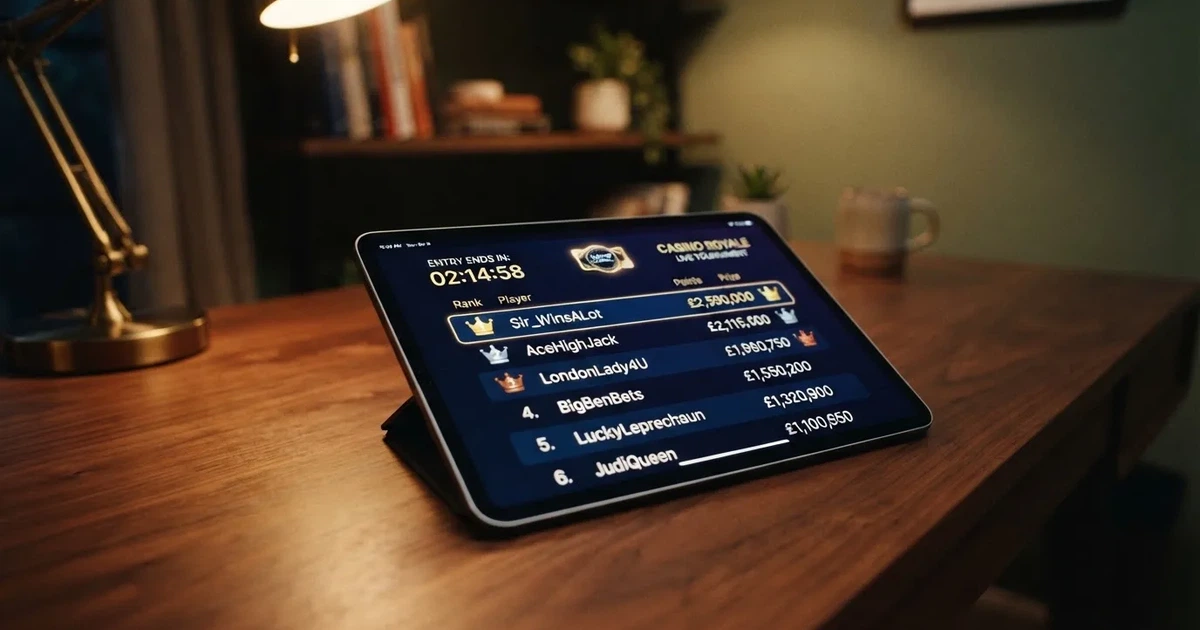
This page works through the formats British casinos run, the price of entry in turnover and time, the operators licensed to host them, and the rules that decide who actually walks away with the prize pool. Figures are current as of 7 November 2026 and have been checked against the Gambling Commission’s public register.
Table of Contents
- Games, studios and tables: what tournaments are actually built on
- Ten UK operators licensed to run slot tournaments
- What a slot tournament actually is
- The licensing picture in Great Britain
- Keeping the competitive side under control
- Cryptocurrency and tournament entry
- How quickly do tournament prizes reach you?
- What the wagering cap actually looks like
- Operator write-ups
- How to read the wider picture
- Tax, payment limits and the rest of the frame
- Operational reminders before the first deposit
- Frequently asked questions
Games, studios and tables: what tournaments are actually built on
A slot tournament is a marketing layer over games that already exist. The reels, the RTP and the volatility come from the studio; only the scorekeeping, the entry fee and the prize split are the operator’s. Which slot titles and which studios show up most often on leaderboards is therefore not a passing curiosity — it decides what any “best slot to play in a tournament” actually means.
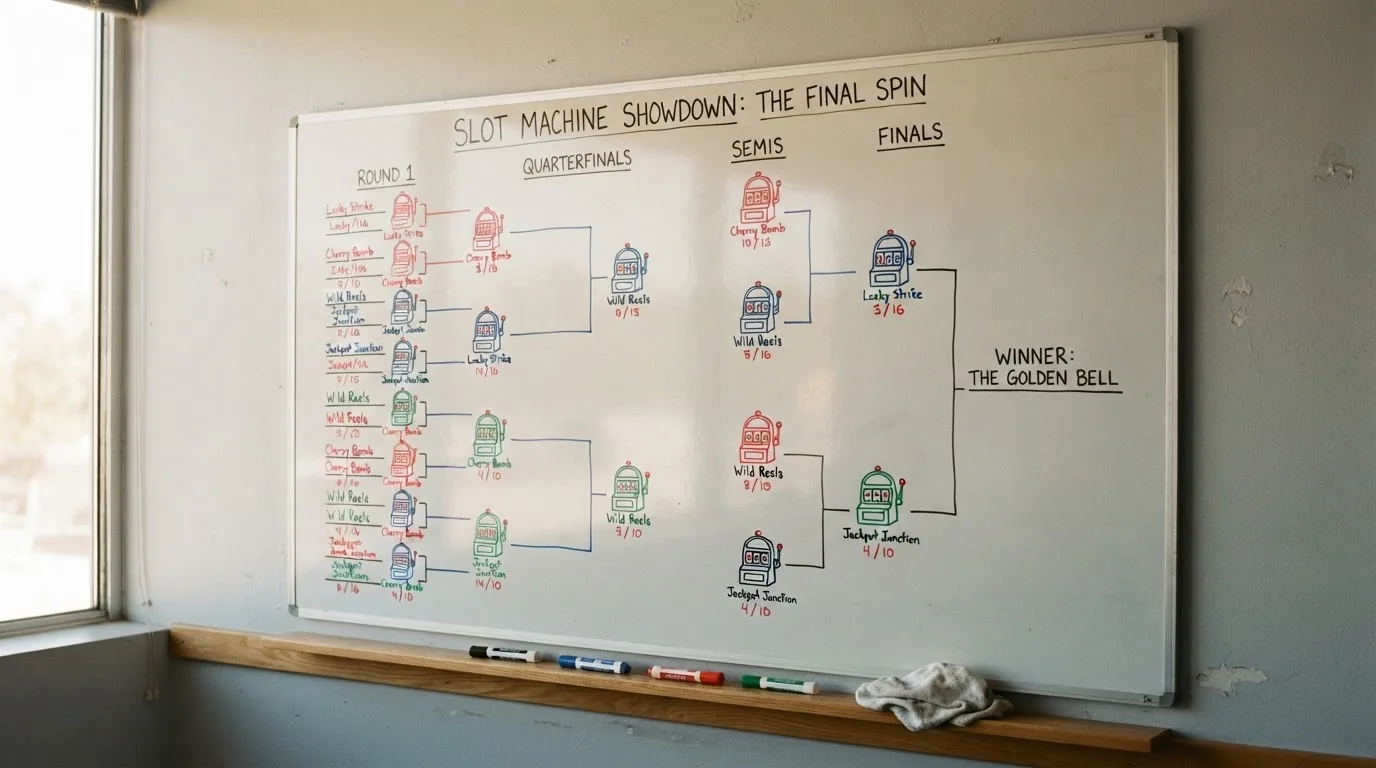
Studio-driven versus operator-run formats
Two flavours sit underneath most tournament marketing. The first is the operator-run leaderboard, where the casino picks a small set of titles (often two or three), gives all entrants a fixed number of spins at a fixed stake, and ranks them by total win. The marketing shines on the prize pool — a few thousand pounds, a guaranteed top prize, free spins on top — but the mechanism is mundane: same spins, same stake, sum the winnings, pay the top N.
The second is the studio-driven drops-and-wins or network tournament, where a provider such as Pragmatic Play runs a campaign across every casino that hosts its games. Entry is automatic on any qualifying spin, the prize pool is funded by the studio (or split with the casino), and the leaderboard resets on a daily, weekly or monthly cycle. The prize amounts look larger because they are — pools of £1m and up are common — but the odds of any single spin landing on a tournament position are vanishingly small.
For a player weighing which to bother with, the practical split is this: operator-run events are small, frequent and beatable by a careful entrant on a quiet midweek evening. Studio network events are big, sprawling and behave like a lottery ticket you receive for free with every spin. Both can pay out. Neither can make a slot’s long-run edge disappear.
Table and live-dealer tournaments
Live-dealer tournaments sit on a different mechanic. Rather than ranking by total win across a session, they rank by the size of a single hand win, the number of consecutive wins, or a points ladder (one point for a win, two for a natural). Game selection is usually restricted to one or two tables (a Pragmatic Live blackjack or a roulette variant), and the prize pool is operator-funded.
These are rarer than slot tournaments at UK-licensed brands and they tend to run for promotional windows of a week or so. They also tend to require a deposit, although some operators credit free entry to accounts that have played a specified amount on the prior week.
Why titles repeat across leaderboards
Look at any week of UK slot tournament listings and the same names come back: Big Bass Bonanza, Sweet Bonanza, Gates of Olympus, Starburst, a couple of jackpot slots. That repetition is not an accident. Studios with a wide portfolio of similar-volatility, medium-RTP games give the operator a small number of titles that every active player already has bookmarked; running a tournament on a niche title would shrink the entry pool to almost nothing. So slots with broad, recognisable names dominate the format — and a player who has a favourite among them can turn that familiarity into faster spins and a steadier rhythm.
Ten UK operators licensed to run slot tournaments
Not every casino can run a tournament for British players. Only operators holding a Gambling Commission remote casino operating licence — the one with the “R” in its number — may legally take tournament entries from anyone in Great Britain. The ten brands below all hold that licence. The list is drawn from the Gambling Commission’s public register and ordered as the Commission lists them, not as a recommendation.
| Brand | Licence holder and GB remote casino licence | Domain status on the register | Subject support |
|---|---|---|---|
| Paddy Power | PPB Games Limited, licence 039411-R-319335-010 | Paddy Power — active | — |
| Ladbrokes | LC International Limited, licence 054743-R-330863-014 | Ladbrokes — active | — |
| MrQ | Tek Fox Ltd, licence 060629-R-337532-004 | MrQ — active | — |
| Coral | LC International Limited, licence 054743-R-330863-014 | Coral — active | — |
| bet365 | Hillside (UK Gaming) ENC, licence 055149-R-331499-004 | bet365 — active | — |
| Betfred | Petfre (Gibraltar) Limited, licence 039544-R-319290-010 | Betfred — active | — |
| Casumo | Recro Limited, licence 061549-R-336718-002 | Casumo — active | — |
| 888casino | 888 UK Limited, licence 039028-R-319297-014 | 888casino — active | — |
| Jackpotjoy | Gamesys Operations Limited, licence 038905-R-319430-022 | Jackpotjoy — active | — |
| Gala Bingo | LC International Limited, licence 054743-R-330863-014 | Gala Bingo — active | — |
Three brands sit under one licence holder: Ladbrokes, Coral and Gala Bingo are all operated by LC International Limited. That is not a flaw in the register — it is the same way Paddy Power, Coral and Sky Bet sit under different Flutter subsidiaries in the wider market. The licence is the unit of regulation; the brand is the unit of marketing.
The register itself, as it stood on 18 September 2026, recorded 139 businesses holding an active remote casino operating licence, with 1,065 active and 361 white-label domain entries sitting under those accounts. A white-label domain trades under another company’s licence — it is a marketing skin, not a separately regulated business. Players who want to verify a brand they have not seen on this list can search the Commission’s public register, which is downloadable in full as a CSV or Excel file.
What a slot tournament actually is
The word “tournament” suggests something competitive and rigorous. In practice the format is thin: a defined window, a defined qualifying game or set of games, a fixed entry stake, and a score, almost always the sum of winnings across a small number of spins. The marketing treats the leaderboard as the contest. The reality is the same slot spinning you would do on a quiet evening, with a price tag attached and a prize pool shared out at the end.
The three formats in regular use
Free-entry tournaments require only a registered account. The casino pays for the entries, runs the leaderboard, and pays out from its own pot. These are the most common format for no-deposit tournament promotions and the one a player who doesn’t want to commit a stake should look for first.
Buy-in tournaments charge a fee — typically £1 to £20 — and use the entry pool as the prize. The format exists but is uncommon at UK-licensed sites, in part because it is hard to square with the regulatory expectation that gambling products be clearly priced and not pitched as investment.
Deposit-gated tournaments are the workaround. The casino credits entries based on deposits or wagering over a defined period — “£10 in real-money wagering earns one tournament entry” — and runs the prize pool from marketing budget. From the player’s perspective the entry costs money; from the regulator’s perspective it is a promotion on top of normal play, not a separate product.
Score, spin and the price of entry
Three numbers govern almost every slot tournament: the entry cost (in cash or wagering), the spin count (50 spins is typical) and the stake (often forced to the game’s minimum so every entrant plays equal hands). Add a time window — usually one to seven days — and you have the contest. What you don’t have is any reduction in the house edge on the qualifying games: the tournament layer sits on top of standard slot math, and a longshot ranking still depends on luck the same way any other spin does.
That is also why most tournaments pay a long tail of small prizes rather than a single jackpot. The casino does not need to dampen the house edge to give a prize — it only needs enough entries to fund the pool. The maths of who wins comes out of who happens to land the biggest wins on the day. The marketing tells you the prize pool; the conditional reality is that the pool is split across hundreds of named positions, and a finishing rank in the top 10% usually pays a few pounds.
Rules worth reading before clicking “join”
Three tournament-specific terms catch players out more than any others. Minimum qualifying bet rules state that a stake below the named threshold does not count, even if the slot allows a smaller bet. Game restrictions rule out bonus-buy features or specific titles that the operator has chosen to exclude from scoring. Prize crediting deadlines say when the prize will be in your account if you win — usually within 24 or 48 hours of the leaderboard settlement, sometimes only after a manual claim.
Read them, then read them again. A “free entry” tournament is only free if your normal play already lands on the qualifying games and stakes. A small thing to miss, and a much larger thing to discover after you’ve spent an hour spinning.
The licensing picture in Great Britain
Every casino that runs a tournament for British players needs a Gambling Commission licence. Section 33 of the Gambling Act 2005 makes it an offence to provide gambling to people in Great Britain without one, regardless of where the operator is based. A Malta, Curaçao or Gibraltar licence is not a substitute: since the Gambling (Licensing and Advertising) Act 2014 came into force, any operator taking customers in Great Britain must hold a Commission licence or face criminal sanction.
The register that confirms this is the Commission’s public register of gambling businesses. It is searchable online, downloadable in CSV and Excel format, and the only authoritative answer to the question “is this operator licensed?”. A licence number printed on a footer is not enough — the licence must be held, the domain must be listed, and the status must read “active” at the moment you deposit.
Remote casino operating licences carry the format account-R-number-suffix. The “R” marks a remote (online) licence, and the leading six digits repeat the licence holder’s account number on the register. Cross-check this against the Commission website before signing up to any brand you have not used before. If the brand is not on the register, the licence number on the footer is either misprinted or stolen, and either way you will not have a Commission complaints route if something goes wrong.
On 18 September 2026 the register listed 139 businesses holding an active remote casino operating licence, with 1,065 active and 361 white-label domain entries across those accounts. That number is the entire universe of UK-facing online casino brands — every tournament you can enter legally sits within it.
Stake limits that apply to tournament play
The £5 maximum stake for over-25s and £2 for 18-24s, in force since 9 April 2025 and 21 May 2025 respectively, apply to every slot spin a player makes at a licensed operator — tournament spins included. So do the 2.5-second spin floor and the ban on auto-play, in force since 31 October 2021. A tournament that quotes a higher stake is either misdescribed or running outside UK rules; either way, walk away.
Age and identity verification
Every licensed operator verifies name, address and date of birth before the first deposit or any play, a requirement in force since 7 May 2019. A tournament site that lets you play without that check is operating outside the regime, which means it is also operating outside the protections a player gets when something goes wrong.
Keeping the competitive side under control
Slot tournaments are not a different product from any other slot play; they are slot play with a leaderboard on top. The competitive layer changes psychology more than mathematics. A player who plans to spend £20 on a quiet evening might find themselves £80 down trying to climb past the player two ranks above them, simply because the leaderboard turns passive entertainment into active pursuit.
Three habits keep the format under control. First, set a time limit before entering, not after — most licensed operators now offer reality-check timers that lock the screen at a configurable interval and require an acknowledgement to continue. Second, decide the entry cost as a fixed spend, not a variable one — if the tournament is buy-in or deposit-gated, treat the entry cost as spent regardless of whether you reach a paid position. Third, register with GAMSTOP if play has felt harder to control than it should — the self-exclusion scheme has been a mandatory condition of every online licence since 31 March 2020, with minimum exclusion periods of six months, one year or five years and no early cancellation.
The financial vulnerability checks that have come in since 28 February 2025 — triggered at £150 in net deposits across a rolling 30 days — apply to tournament play too, though the prompt runs against deposits, not against leaderboard positions. The wider affordability checks, flagged as coming, were not yet in force as of the register snapshot in this section.
Anyone who needs to talk to someone now can reach the National Gambling Helpline (GamCare) or use the support channels run by GambleAware. The Gambling Commission’s own pages list both.
Cryptocurrency and tournament entry
Cryptocurrency deposits sit in an awkward place in the UK tournament market. The licensed operators in this ranking list take card and bank-transfer deposits, sometimes e-wallets and Apple Pay. None of them list Bitcoin, Ethereum or stablecoin as a deposit route. The reason is regulatory: anonymous play is not possible at a licensed site, and on-chain deposits — by their nature pseudonymous before any off-ramp — sit on the wrong side of that line.
The crypto-casino tournament market exists, but it sits offshore. A player looking at a Curaçao-licensed site offering crypto-funded slot tournaments should weigh the brighter offers against the absence of a Commission licence: no GAMSTOP enforced by the brand, no approved alternative dispute resolution, no Commission complaints route. Section 33 of the Gambling Act 2005 still applies — providing gambling to people in Great Britain without a Commission licence is the offence — but the practical reality is that the Commission disrupts illegal sites through cease-and-desist notices, search-engine delisting and payment and hosting referrals, and has no ISP-blocking power. No penalty is aimed at the player; what the player loses on an unlicensed site is the protection framework.
For a British player who wants to enter a slot tournament at a UK-licensed casino, the practical answer is unchanged: card payment, faster bank transfer or an accepted e-wallet will all work. Crypto routes don’t add anything here except a less certain route home if a withdrawal goes wrong.
How quickly do tournament prizes reach you?
The time between a leaderboard settling and a prize landing depends on two things: how the operator pays, and how the player withdraws. A free-spin prize (free-spins bundle rather than cash) is usually credited instantly, but it carries its own wagering requirement at the regulated 10x cap and any winning converted from bonus funds is paid only after that wagering is met. A cash prize — paid directly into the player’s real-money balance — lands the same way any other withdrawal would.
The deposit and withdrawal pipeline
UK-licensed operators accept card (debit only since 14 April 2020), bank transfer (typically through Faster Payments, settled instantly or within a couple of minutes and capped per transaction at £1,000,000), Apple Pay, and a range of e-wallets. Most payout times cluster around one to three business days once a withdrawal is initiated, with some operators offering same-day payouts on the Faster Payments rails. The Faster Payments Service itself has been running since 2008, is operated by Pay.UK, and is generally available 24/7.
AstroPay — a digital wallet founded in 2009 and headquartered in Uruguay — is one of the e-wallets you may see at UK-licensed operators. Its UK entity, Larstal Limited, is an electronic money institution authorised by the Financial Conduct Authority under the Electronic Money Regulations 2011, and the broader group operates regulated entities in the Isle of Man, Brazil and Denmark. Players can use it for online payments, virtual and physical debit cards, and peer-to-peer transfers. Whether a particular operator accepts it for tournament-related deposits or withdrawals depends on that operator’s own payment page.
Apple Pay, accepted at most large UK casinos, works a little differently for online gambling: card data is protected through tokenisation — the actual card number is replaced with a device-specific tokenised Device Primary Account Number and each transaction generates a dynamic security code. Online deposits typically run through the player’s iCloud-linked card, with Face ID or Touch ID authentication. Apple Pay launched in the US on 20 October 2014 and supported UK-issued payment cards from 14 July 2015. It’s worth noting that credit cards cannot be used to fund gambling under any route, including Apple Pay funded from a credit card — the Commission’s ban covers credit cards even when routed through e-wallets.
No-deposit tournament entry
No-deposit tournaments — the formats that credit entries to a registered account without a prior deposit or wagering requirement — settle the fastest of all, because no cash movement is needed to enter. Prizes from these events are usually credited in bonus funds rather than cash, and the wagering cap of 10x (in force since 19 December 2025) applies to the conversion of bonus funds to withdrawable cash. A free-spins prize worth £10 might need £100 of wagering at the qualifying game before any of it can be taken out.
For cash prizes, the “free tournament, paid in cash” combination is rarer. When it appears, it tends to be a limited promotional window around a new game launch, and the prize is usually capped to keep the marketing math working — £100 cash top prizes are more common than £1,000 ones.
What the wagering cap actually looks like
The 10x wagering cap on casino bonuses that came in on 19 December 2025 has reshaped how no-deposit tournament prize funds convert to withdrawable cash. Take the simplest case as a worked example. A player wins a free-entry tournament and the prize is a £20 bonus credited to their account. The wagering factor on casino bonuses is capped at 10x, so the required turnover to convert the bonus to withdrawable cash is £20 × 10 = £200 of qualifying slot play. At a typical slot spin of 50p, that takes 400 spins. At the regulated 2.5-second-per-spin floor on UK slots, that is roughly 1,000 seconds, or about 17 minutes.
What that £200 turnover actually costs in expectation depends on the RTP of the qualifying slot. At a 96% RTP (a typical figure for the games on most tournament leaderboards), the expected loss is £200 × (1 − 0.96) = £8. Higher-volatility slots — the kind a player might pick for the chance to clear their wagering requirement with one big win — push that figure higher; lower-volatility slots push it lower. Either way, the cost is the cost of clearing the bonus at the regulator’s wagering rate, not the prize itself.
A worked example in bands makes the point more clearly. A £5 bonus with 10x wagering requires £50 in turnover; a £50 bonus with the same cap requires £500; a £500 bonus requires £5,000. The turnover tracks the bonus linearly because the wagering factor is fixed at the cap. What does not track linearly is the house-edge cost: a £500 turnover with 4% house edge is £20, the same proportion of the stake as the £5 case is of £50. The point of the cap is not to make bonuses fair — the house edge takes care of unfairness on its own — but to stop the marketing arms race that pushed pre-2026 wagering factors into 40x territory.
Since the same date — 19 December 2025 — mixed-product bonuses are also banned. A “bet £10 on football, get 100 slot tournament entries” structure is no longer permitted at any UK-licensed operator, regardless of how the offer is presented in the marketing.
Operator write-ups
Ten UK-licensed brands, ordered as the Commission’s public register lists them. Each write-up is descriptive, not promotional: the licence, the licence holder, what stands out about the brand’s tournament format where research supports a finding, and what the entry path looks like. No recommendation follows. The choice is the player’s.
Paddy Power — the high-volume leaderboard
Paddy Power’s domain (Paddy Power) sits on the Commission’s register as an active domain of account 39411, with the remote casino operating licence 039411-R-319335-010 held by PPB Games Limited. The Flutter-owned group runs a large, continuously refreshed promotional calendar, and tournament slots form a regular layer across the casino product rather than a single signature event.
The brand’s strength is its churn of promotions: a new tournament starting every few days, often free-entry, often short-windowed. That pace suits a player who enjoys the format regularly but does not want to plan around a single event. The downside is that no single tournament is large enough to make a meaningful dent in any player’s bankroll.
Ladbrokes — shared back office, familiar calendar
Ladbrokes operates as an active domain of account 54743, and the licence holder — LC International Limited — also runs Coral and Gala Bingo under the same remote casino operating licence 054743-R-330863-014. Players who have used one of those brands will recognise the tournament structure on the others: same software stack, similar promotional windows. The licensing picture is identical because the operator is identical.
For tournament players, the practical implication is that an account at Ladbrokes and an account at Coral are not independent bookings. The Commission regulates LC International Limited; what runs on top of the licence is the brand. A player who finds one of these brands more pleasant to use than another can stick to it without losing anything regulatory.
MrQ — the smaller-ledger operator
MrQ.com sits on the Commission’s register under account 60629, with Tek Fox Ltd holding the remote casino operating licence 060629-R-337532-004. MrQ is a smaller operation than the Flutter or Entain brands in this list, and its tournament calendar runs less frequently — but its no-deposit bonuses and free-spin offers have tended to be a touch more generous than the larger operators, which is the trade-off a smaller ledger offers.
A player looking for a small pool with a higher chance of a paid position would find the format attractive here; a player looking for the largest prize pools in the segment will not.
Coral — same engine, different paint
Coral.co.uk is listed as an active domain of account 54743, with the licence 054743-R-330863-014 sitting under LC International Limited — the same licence holder as Ladbrokes. Tournament pages, qualifying games and prize structures largely track whatever Ladbrokes runs. Players who have an account at one of the LC International brands can use the other’s tournaments without re-verification, and the customer’s GAMSTOP registration applies across the whole estate.
bet365 — the wider-product operator
Bet365.com sits on the Commission’s register under account 55149, with Hillside (UK Gaming) ENC holding the remote casino operating licence 055149-R-331499-004. The bet365 brand is one of the few full-spectrum operators in the UK, with sportsbook, poker, bingo and casino sharing one wallet; the tournament layer sits inside the casino product and tends to run on a small, focused set of games.
A player with an existing bet365 sportsbook account can use that login for casino tournaments without re-verification. The drawback is the same as Paddy Power’s: the promotional calendar runs fast and the individual prize pools do not set records.
Betfred — Gibraltar-rooted, UK-licensed
Betfred operates as an active domain of account 39544, with Petfre (Gibraltar) Limited holding the remote casino operating licence 039544-R-319290-010. The Gibraltar-registered entity holds the GB licence directly, and the regulatory status is therefore the same as any other UK-facing operator — the Gibraltar registration is the corporate vehicle, not a substitute for the Commission licence.
The brand’s tournament offering tends to focus on free-entry formats tied to its in-house slot games and a smaller number of third-party studios. Players looking for a steady calendar of small, low-commitment events will find it here.
Casumo — the adventure-led brand
Casumo operates as an active domain of account 61549, with Recro Limited holding the remote casino operating licence 061549-R-336718-002. Casumo’s product layer includes a long-running loyalty programme alongside the casino games, and tournament promotions tend to slot into that programme — entries can come from the loyalty ladder as well as from direct opt-in.
Players whose preferred style is a long-running account at a smaller-to-mid-size operator will recognise the format. The pace of new tournaments is steadier than the major-brand cadence, but the prize pools are correspondingly tighter.
888casino — the larger-prize arm of 888 UK
888casino is listed as an active domain of account 39028, with 888 UK Limited holding the remote casino operating licence 039028-R-319297-014. The 888 group sits separately from the Flutter and Entain groupings in this list, and the casino brand runs a wider portfolio of slot games under the 888 own brand and the Williams Interactive and Random Logic labels it owns.
The brand’s tournament format has historically tilted to longer windows with larger top prizes, balanced by a smaller player pool on the lower-ranked prize positions. A patient player chasing a single big payout can find it here.
Jackpotjoy — Gamesys-operated, jackpot-led
Jackpotjoy operates as an active domain of account 38905, with Gamesys Operations Limited holding the remote casino operating licence 038905-R-319430-022. The Gamesys stack is the same one that runs Virgin Games and a number of other bingo-led brands; the casino product is one layer on a bingo-leaning estate.
Players who enjoy bingo formats often sit naturally on Jackpotjoy, and the tournament layer is thinner than a dedicated casino brand’s would be. Where it exists, it tends to be free-entry and short.
Gala Bingo — third LC International brand
Gala Bingo operates as an active domain of account 54743 — the same account as Ladbrokes and Coral — with LC International Limited again holding the licence 054743-R-330863-014. The bingo root of the brand shows in the tournament product: most slots-side events run on the same engine as Ladbrokes and Coral.
A player who finds one of the LC International brands familiar has not gained anything by switching to another within the group; a player who wants genuine product variety will look at the other licence holders in this list.
How to read the wider picture
Step back from any single operator and the shape of the UK slot tournament market is this. The Gambling Commission licences 139 businesses to run remote casino products, and almost all of them run a tournament layer over their slots. The £5 (over-25s) and £2 (18-24s) maximum stake caps apply across the board, so any tournament spin runs at or below the regulatory cap. The 10x wagering cap on bonuses — in force since 19 December 2025 — applies to any bonus-funded prize a player wins. Anonymous play is not available at any licensed brand. Credit cards have been banned as a funding method since 14 April 2020, and that covers credit cards routed through e-wallets too.
For a player choosing between the ten operators in this ranking, the meaningful variables are tournament cadence (large operator, smaller operator), entry style (free-entry, deposit-gated, buy-in), prize pool shape (long tail of small prizes versus single large top prize), and qualifying games (broad library of familiar slots versus narrower selection). The licence is the same on all of them. So is the regulatory framework.
What that framework does not do is make the tournaments fair. The house edge remains; the leaderboard does not change the long-run arithmetic of the slot underneath. What it does is offer a path to a one-off payout that the regular play does not. A careful entrant knows the difference, sets a spend ceiling, and treats any finished position above zero as a bonus rather than a return.
Tax, payment limits and the rest of the frame
UK players pay no tax on gambling winnings. That is unchanged in the recent budget cycles and is the cleanest fact on this page: a tournament prize paid to a player’s account is theirs in full, with no HMRC conversation in the background.
Operators, on the other hand, pay Remote Gaming Duty. That duty was raised from 21% to 40% from 1 April 2026, and the change is structural rather than cosmetic — it shifts the operator’s economics and is one reason a number of smaller operators have left the UK market in the past year. For a tournament player, the practical effect is at one remove: prize pools may trend smaller, free-entry promotions may trend more frequent (since they cost the operator marketing budget rather than cash) and buy-in formats may become less common.
There is no state-set deposit or loss ceiling at a UK-licensed casino. Operators must now prompt a customer to set a financial limit before the first deposit — a rule in force since 31 October 2025 — but no ceiling is enforced by the regulator beyond the existing affordability checks. GAMSTOP, the national online self-exclusion scheme, is mandatory on every online licence. Auto-play is banned. Spin speeds are floored at 2.5 seconds. Losses disguised as wins are banned. Off-topic some of these may seem to slot tournaments — none of them is off-topic; all of them apply to a tournament spin.
Players who want to take a break can do so directly through any licensed operator’s responsible-gaming page, or through GAMSTOP itself for the longer exclusion periods. None of this is unique to tournaments, and none of it stops being relevant the moment the leaderboard on screen flips to “competing”.
Operational reminders before the first deposit
Three things to do before clicking “enter tournament” on any brand, whether one of the ten in this ranking or one of the other 129 businesses on the Commission’s register. Verify the licence number against the Commission’s public register — the licence format is account-R-number-suffix, the “R” stands for remote, and the leading six digits repeat the licence holder’s account number. Confirm the brand’s domain is listed on the register under that licence holder with an active status. Make sure the GAMSTOP self-exclusion record (if any) covers the brand — GAMSTOP registration blocks all UK-licensed operators, so a player who has signed up is automatically barred.
Two things not to skip. Read the terms page for the specific tournament — the minimum qualifying bet, game restrictions and prize crediting deadlines vary more between events than between brands. And set a personal ceiling on what you intend to spend in pursuit of the leaderboard, the way you would for any other gaming session. The leaderboard changes the psychology, not the underlying edge.
Frequently asked questions
How do online slot tournaments work at UK casinos?
A slot tournament is a leaderboard contest run by a casino or a slot studio. Players get a fixed number of spins at a fixed stake on one or more named games, and the casino ranks them by total winnings during the contest window. The operator funds the prize pool — usually a long tail of small prizes — and the house edge on the qualifying games is unchanged.
Can I enter a slot tournament without making a deposit?
Yes, at any of the ten operators in this ranking. Free-entry tournaments credit tournament entries to a registered account without requiring a deposit or a minimum wager. The catch is that prizes are usually paid in bonus funds rather than cash, so the standard wagering cap (10x in force since December 2025) applies before the prize can be withdrawn.
What determines my ranking on a tournament leaderboard?
Almost always, the sum of winnings across a fixed number of qualifying spins. Some live-dealer tournaments use a points system (one point per win, extra points for streaks or naturals) instead. The qualifying game’s RTP, the stake and the spin count are spelled out on the tournament’s terms page, and they don’t change between entrants.
How quickly are tournament prizes paid out?
Free-spins or bonus-fund prizes are credited instantly to the winner’s account but carry a wagering requirement. Cash prizes are credited once the leaderboard settles, which is typically within 24 or 48 hours of the tournament closing. Withdrawals from there depend on the payment method — Faster Payments and most debit cards settle within hours, while bank transfers via slower rails can take up to a couple of days.
Do crypto deposits count towards tournament entry the same as card payments?
Not at any UK-licensed operator — none of the ten in this ranking accept cryptocurrency. Crypto-funded tournaments exist in the offshore market, but those sites do not hold a Gambling Commission licence and therefore lack the protections a Commission-licensed brand is required to offer (GAMSTOP, ADR, complaints route).
What tips help with slot tournament strategy?
Three habits help more than any spin-timing trick. Read the terms for minimum qualifying bet and game restrictions before entering. Set a personal spend ceiling as if the entry fee were already spent. Pick familiar, mid-volatility games over niche slots — your existing rhythm is worth more than any slot’s marginal RTP difference over a small spin window.