Casino sites that accept credit card UK: where the 2020 ban leaves a UK player
 Available in GB
Anyone arriving at this page has probably typed a version of the same question — can I still pay for online casino with a credit card in the UK? The short answer is no, not at a licensed British casino, and not since 14 April 2020. The longer answer is what this page works through: what the Gambling Commission’s ban covers, where the gap between rule and practice shows up, what a UK player actually uses at the checkout instead, and how the ten brands sitting on the Commission’s public register handle deposits on the other side of the rule.

The data behind this page is current as of 23 September 2026, and was checked against the Gambling Commission’s public register of gambling businesses.
Table of Contents
- The £5 slot stake and the 10× cap: the new shape of a UK casino bonus
- How a UK casino is built around the credit card ban
- The ten licensed brands on the register, set against the credit card question
- What the public register actually shows, and what it does not
- Side-by-side: the ten brands against the credit card question
- The deposits that replace credit cards at a UK cashier
- The rules that sit on top of how a UK player pays
- What a UK player loses on an offshore site that takes credit cards
- What a UK player actually does at the cashier today
- The arithmetic behind the credit card ban
- What changed at the cashier on 14 April 2020
- Why this page does not recommend a brand
- Frequently asked questions
The £5 slot stake and the 10× cap: the new shape of a UK casino bonus
Two regulatory changes set the floor under every bonus a UK casino can advertise in 2026, and both reach further than the headlines about them. The first is the per-spin stake cap on online slots. Players aged 25 and over face a maximum stake of £5 per game cycle from 9 April 2025; players aged 18 to 24 face a tighter cap of £2 per game cycle from 21 May 2025. The second is the wagering-requirement cap. Since 19 December 2025, no bonus offered to a British customer can carry wagering above 10× the bonus amount, and a bonus that mixes products (free spins bundled with a sports free bet, for instance) is no longer permitted at all.

What that does to a bonus is best shown as a band rather than a single figure, because the inputs vary by offer. Take a £100 welcome bonus with the standard 10× wagering cap. Required turnover sits at £1,000 — bonus × wagering factor. At the £5-per-spin stake cap, that is 200 spins; at the £2 cap for younger players, 500 spins. A spin takes a minimum of 2.5 seconds at a UK-licensed site, so the £5-spent, £100-bonus path runs roughly 500 seconds of play, the £2-spent path runs roughly 1,250 seconds. Real sessions drift past both, because a player usually adds their own bankroll on top and the house edge keeps dragging the balance downward. The honest gloss is this: at the 10× cap, clearing a bonus is a matter of minutes to a couple of hours at the regulated stake, not the days-long grind the old 30× and 40× multiples produced. That is the regulator’s point. It is also why no UK bonus can promise what a 30× offer once did — the player’s expected loss during the clear is now a small fraction of what it used to be, and so is the bonus’s value once cleared.
How a UK casino is built around the credit card ban
The credit card ban did not arrive as a tweak. On 14 April 2020 the Gambling Commission prohibited every operator it licences from accepting a deposit funded by a credit card, in any form of remote gambling and in non-remote betting. The only carve-out is non-remote lotteries, where face-to-face ticket sales still allow credit card payment. The Commission also closed the obvious workaround: a credit card routed through an e-wallet is treated as a credit card deposit unless the e-wallet provider can demonstrably block the credit-card funding at source.

Why the rule exists sits in the evidence the Commission published ahead of the ban. Research it cited found that 22% of online gamblers using credit cards to gamble fell into the problem-gambling category — a markedly higher rate than the rest of the online customer base. UK Finance data the Commission referenced showed roughly 800,000 UK consumers had used a UK-issued credit card to gamble during 2018. The mechanism behind both numbers is the same one any credit card enables: a customer spends money they have not earned yet, and the debt sits on a monthly statement where it can quietly accumulate.
A bank-side layer sits behind the Commission rule and shapes how it actually plays out. HSBC, for instance, declines credit card payments it identifies as gambling based on the merchant category assigned by Mastercard or Visa, and that block sits on every HSBC credit card with no opt-out. HSBC also makes clear it cannot guarantee that every gambling transaction will be blocked, and that the customer remains liable for any that get through. Monzo went further in 2018, becoming the first UK bank to ship an in-app gambling block; a customer picks a cooldown of anywhere from 2 days to 1 year, and the block cannot be switched off during that window. Over 275,000 Monzo customers have since activated the feature. The Commission rule is what stops the casino from accepting the deposit; the bank-side block is what stops the deposit from ever reaching the casino’s checkout.
The ten licensed brands on the register, set against the credit card question
The brands below all hold an active remote casino operating licence from the Gambling Commission. Each is taken from the Commission’s public register, which anyone can search online or download as a CSV file. None of them accept credit card deposits — that is the rule, applied uniformly to every licence holder.
Betfair — the long-running exchange paired with a casino floor
Betfair runs on a Gambling Commission remote casino operating licence held by PPB Games Limited (account 39411), with Betfair.com listed on the register as an active domain. The brand is best known for its betting exchange, but the casino and games side of the house sits under the same licence and the same set of safer-gambling controls — GAMSTOP enrolment, identity verification before first deposit, the £5 and £2 slot stake caps, and the 10× wagering ceiling on any bonus it advertises. The Commission’s ban on credit card deposits applies in full; debit cards, bank transfer and a closed list of approved e-wallets are what a Betfair customer actually uses at the checkout.
Betfair is a practical choice for a player wanting both an exchange and a casino under one licence, benefitting from the full Commission safer-gambling envelope and no credit card funding.
kwiff — the surprise-bonus model under a relatively young licence
Kwiff operates under a Gambling Commission remote casino operating licence held by Eaton Gate Gaming Limited (account 44448), with Kwiff.com listed as an active domain. The brand’s selling point is its “surprise” mechanic — boosted odds or unexpected bonus drops that land on a customer rather than being advertised in advance — and that mechanic is what the wagering-requirement cap squeezes hardest, because surprise rewards cannot lawfully carry wagering above the 10× ceiling or mix products the way older surprise offers sometimes did.
A player who likes the surprise mechanic and is happy to take what the brand doles out within the regulated bonus envelope will find kwiff an unusual fit; a player who prefers to read the full bonus terms before claiming will find the surprise framing less comfortable, even with the cap in place.
888casino — the longest-established brand on this list
888casino operates under a Gambling Commission remote casino operating licence held by 888 UK Limited (account 39028), with 888casino listed as an active domain. The brand has run a UK-facing casino under Commission oversight since the 2014 licensing regime came in, and the casino product has been pruned and rebuilt around British safer-gambling rules several times since — most recently around the slot stake caps and the bonus restrictions of late 2025. A credit card deposit has not been an option at any point under the current regime; debit cards and a small set of e-wallets are what an 888casino customer funds the account with.
888casino offers a familiar experience for those seeking a brand that has consistently rebuilt its product around UK rules since the 2014 regime began.
Grosvenor Casinos — the high-street name with a Commission-licensed online floor
Grosvenor Casinos operates online under a licence held by Rank Interactive (Gibraltar) Limited (account 57924) and regulated by the UKGC, with Grosvenor Casinos listed as an active domain. The land-based estate is the brand’s identity, but the online casino sits under the same licence account and inherits the same Commission-mandated controls — GAMSTOP, deposit-limit prompts before the first deposit, the slot stake caps, the wagering cap. A Grosvenor online customer cannot fund the account with a credit card; debit cards and a short list of approved methods are what the cashier accepts.
Grosvenor Casinos is a natural bridge for a player who appreciates the connection between the high-street brand and the online casino floor, provided with the full Commission safer-gambling envelope.
Gala Bingo — the bingo heritage under LC International
Gala Bingo operates under a UKGC-issued remote licence held by LC International Limited (account 54743), with Gala Bingo listed as an active domain. The brand heritage sits in bingo, but the casino product on the same site is licensable under the same remote licence and follows the same Commission rules on credit cards, deposit limits and bonus wagering. LC International also holds the licences for Ladbrokes and Coral, which is why three very different customer-facing brands sit under the same licence account and the same set of safer-gambling controls.
For a bingo player who wants a casino tab on the same site, under a single Commission licence and a single safer-gambling envelope, Gala Bingo is a reasonable fit.
Virgin Games — the white-label model, plainly recorded
Virgin Games operates as a white-label site, authorised by the UKGC under the remote licence of Gamesys Operations Limited (account 38905), with Virgin Games listed on the register as a white-label domain. White-label means the brand trades under another company’s licence; Gamesys runs the platform and the safer-gambling controls, and Virgin Games sits on top of it. The Commission’s ban on credit card deposits applies through the licence, exactly as it does for any active domain; a Virgin Games customer funds the account via debit card, bank transfer or a regulated e-wallet.
For a player who likes the Virgin branding and is comfortable with the white-label structure, Virgin Games is the honest pick — the register makes the arrangement visible rather than burying it.
PokerStars — the poker-led brand under Stars Interactive
PokerStars holds a remote gambling licence from the UKGC for Stars Interactive Limited (account 39108), with Pokerstars.uk listed as an active domain. The brand’s centre of gravity is poker, but the casino product on the same licence account is regulated to the same Commission standard — credit card deposits banned, GAMSTOP enrolment mandatory, slot stake caps applied, wagering ceiling enforced. The 10× cap matters more here than at most competitors, because poker-style bonus structures have historically carried heavier wagering than casino welcome offers.
For a poker player who wants a casino tab on the same site, with the Commission’s full envelope applied and no credit card funding, PokerStars is the natural fit.
32Red — the long-standing casino-only brand
32Red operates under a UKGC remote licence held by Platinum Gaming Limited (account 45322), with 32red listed as an active domain. The brand has run a UK-facing online casino for the better part of two decades and rebuilt its bonus terms around the 10× cap and the ban on mixed-product bonuses. A 32Red customer funds the account with debit card, bank transfer or a regulated e-wallet; credit cards are not accepted, by rule rather than by choice.
32Red stands out as a clean, long-standing casino-only option for players prioritizing a brand with a deep history of adherence to UK regulatory standards.
bet365 — the biggest UK-facing brand, on the same rule as everyone else
bet365 operates under a remote licence held by Hillside (UK Gaming) ENC (account 55149) and regulated by the UKGC, with Bet365.com listed as an active domain. The brand’s scale does not exempt it from the credit card ban — the rule applies to every licence holder, and Hillside’s cashier rejects credit card deposits in the same way every other Commission-licensed cashier does. The 10× wagering ceiling applies to every bonus bet365 advertises to a UK customer, and the £5 and £2 slot stake caps apply to the casino games on the same account.
bet365 represents the largest UK-facing brand, ensuring that players receive the full benefit of the Commission’s safer-gambling envelope on every casino session.
MrQ — the no-wagering model under the new cap
MrQ operates under a remote licence from the UKGC held by Tek Fox Ltd (account 60629), with Mrq.com listed as an active domain. The brand’s pitch has long been no-wagering bonuses — free spins paid as cash, no playthrough — and that pitch sits comfortably under the 10× cap because no playthrough is well below the ceiling. The credit card ban applies in full; MrQ customers fund the account with debit card and a regulated e-wallet, not credit card.
For a player who likes the no-wagering model and is happy to take smaller bonuses in exchange for keeping what they win, MrQ is the most distinctive fit on this list.
What the public register actually shows, and what it does not
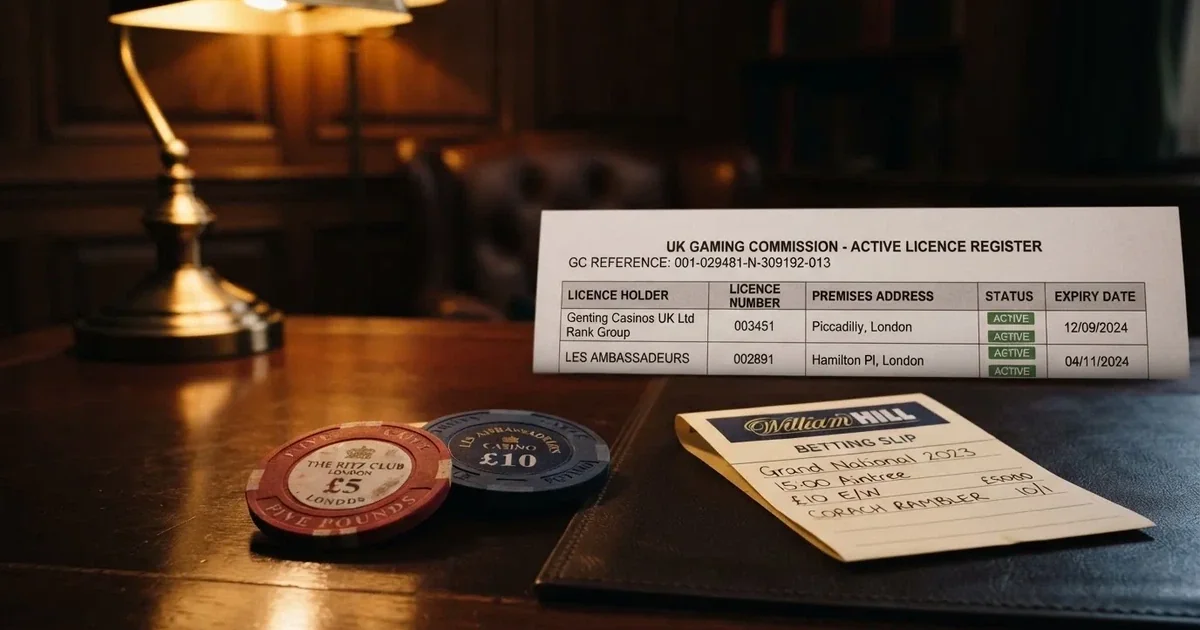
The Commission’s public register is the document this page leans on. On 18 September 2026 the register listed 139 businesses holding an active remote casino operating licence; the same register held 1,065 active and 361 white-label domain entries, with each website’s status logged as Active, Inactive or White Label. A white-label site trades under another company’s licence — Virgin Games on Gamesys Operations Limited’s licence is the clearest case on this list. The register is searchable online and downloadable in CSV or Excel form, which is how a reader can verify any licence number cited here without taking the page’s word for it.
A remote casino licence number follows the form account-R-number-suffix, where the leading six digits repeat the licence holder’s account number and the R marks a remote (online) licence. That format matters because it is the only reliable way to tell a real Commission licence from a marketing claim. A brand with no licence number on this register is not licensed to take GB customers, and a deposit at that brand carries none of the protections this page describes — no GAMSTOP, no Commission complaints route, no approved ADR, and the Commission’s enforcement against the operator does not undo losses a player has already taken.
Side-by-side: the ten brands against the credit card question
The table below sets each reviewed brand against the Commission’s register. The “subject support” column reflects what each operator’s licence and registered status show about the credit card question — and the answer for every brand here is the same: no licensed UK casino accepts credit card deposits, because the ban applies to the licence, not to the brand.
| Brand | Licence holder and GB remote casino licence | Domain status on the register | Credit card deposits |
|---|---|---|---|
| Betfair | PPB Games Limited, 039411-R-319335-010 | Active | Not accepted |
| kwiff | Eaton Gate Gaming Limited, 044448-R-323408-017 | Active | Not accepted |
| 888casino | 888 UK Limited, 039028-R-319297-014 | Active | Not accepted |
| Grosvenor Casinos | Rank Interactive (Gibraltar) Limited, 057924-R-334666-005 | Active | Not accepted |
| Gala Bingo | LC International Limited, 054743-R-330863-014 | Active | Not accepted |
| Virgin Games | Gamesys Operations Limited, 038905-R-319430-022 | White Label | Not accepted |
| PokerStars | Stars Interactive Limited, 039108-R-319334-026 | Active | Not accepted |
| 32Red | Platinum Gaming Limited, 045322-R-324275-019 | Active | Not accepted |
| bet365 | Hillside (UK Gaming) ENC, 055149-R-331499-004 | Active | Not accepted |
| MrQ | Tek Fox Ltd, 060629-R-337532-004 | Active | Not accepted |
The pattern in the table is the point. The brand, the licence holder and the licence number change; the answer to the credit card question does not. A reader comparing these brands on game choice, customer support or account limits will find real differences; a reader comparing them on whether they accept credit card deposits will find a flat column.
The deposits that replace credit cards at a UK cashier
Three methods do the work a credit card once did at a UK casino cashier. Debit cards are the most common — Visa Debit and Mastercard Debit are accepted at every brand on this list, deposit typically within seconds, withdrawal back to the same card follows the standard settlement window. Bank transfer covers larger deposits and is the method a player tends to use for amounts above the debit card ceiling. E-wallets — PayPal, Skrill, Neteller, Apple Pay and a small set of others — sit on top, with their own approval status; the Commission’s rule closes the loophole that lets a credit card fund an e-wallet and then fund a casino, unless the e-wallet provider can demonstrably block that path at source.
Apple Pay is the e-wallet that has had the most regulatory scrutiny in recent years. Apple Pay launched on 20 October 2014, initially supporting only US-issued payment cards; UK-issued card support followed on 14 July 2015. The technology that underpins it replaces the actual card number with a device-specific tokenised Device Primary Account Number and generates a dynamic security code per transaction, so the merchant never sees the real card number. In-store payments use near-field communication to talk to contactless terminals; on an iPhone with Face ID, the customer double-clicks the side button to authenticate, and on Touch ID models the Home button. The November 2024 US Consumer Financial Protection Bureau rule that brought large nonbank digital wallet operators under bank-like federal oversight, and the European Commission’s 2020 investigation into whether Apple abused its control of iPhone NFC hardware, both speak to how seriously regulators treat the wallet layer — including, indirectly, how the Commission’s 2020 ban on credit card funding of gambling transactions has to hold against wallet routing.
AstroPay is a smaller-scale option worth naming for completeness. Founded in 2009 and headquartered in Uruguay, AstroPay operates as a global digital wallet offering online payments, virtual and physical debit cards, and peer-to-peer transfers; it spun off its payment-processing business, dLocal, as a separate company in 2016. AstroPay’s UK entity, Larstal Limited, is an electronic money institution authorised by the Financial Conduct Authority under the Electronic Money Regulations 2011 — which means the wallet sits inside the FCA’s regulated perimeter, and a UK customer funding a casino through Larstal is funding it through an FCA-authorised e-money institution, not through an unregulated intermediary.
The rules that sit on top of how a UK player pays
Four Commission rules apply to every deposit at every brand on the table above, regardless of which method funds it. They are the practical layer a UK player meets at the cashier, and they explain why a licensed British casino feels more constrained than an offshore one.
Identity verification comes first. Name, address and date of birth are checked before the first deposit or any play, a rule in force since 7 May 2019. A credit card deposit at a licensed UK casino never got past this gate anyway, because the deposit method was banned before verification could complete; a debit card deposit today goes through the same gate.
GAMSTOP self-exclusion sits underneath. Every online licence carries GAMSTOP enrolment as a mandatory condition, in force since 31 March 2020, with self-exclusion periods of six months, one year or five years and no early cancellation. A player who has registered with GAMSTOP cannot deposit at any brand on this list, by credit card, debit card, bank transfer or e-wallet — the block is at the operator level, not the funding level.
Financial limits are prompted before the first deposit. From 31 October 2025, every UK-licensed operator must prompt the customer to set a financial limit before the first deposit goes through. There is no state-set deposit or loss ceiling — the limit is the customer’s own choice, but the prompt is mandatory, and the operator records it.
Slot stake caps run while the session is live. Auto-play is banned and a spin cannot be faster than 2.5 seconds since 31 October 2021, and losses disguised as wins are banned. The £5 and £2 per-spin caps are the visible edge of that regime. A player on a £5-per-spin slot is not making a single £100 spin, no matter how large the bankroll — the slot will not accept it. The reality check prompt, which fires at fixed intervals during a session, sits beside the stake cap and is the operator’s way of reminding a player how long they have been at it.
What a UK player loses on an offshore site that takes credit cards
The contrast this page sets up is between a Commission-licensed cashier and an offshore one. The latter will take a credit card deposit, because no Commission rule binds it; the former will not, because the rule applies to the licence. The price of taking the credit card is what the player gives up by sitting outside the Commission’s perimeter.
GAMSTOP does not reach an offshore site. A player who has self-excluded through GAMSTOP and then opens an offshore account in a jurisdiction the Commission does not regulate will find the GAMSTOP block is irrelevant at that site — the operator never enrolled. The Commission’s enforcement against the offshore operator is real (cease-and-desist notices, search-engine delisting, payment and hosting referrals), but it does not undo losses a player has already taken, and it does not give the player a complaints route or an ADR.
Identity verification is the operator’s choice offshore, not the rule. A UK customer at an offshore site may be asked for documents or may not be, depending on the operator’s own policy and the payment provider’s view. A UK customer at a Commission-licensed site is always asked, before the first deposit.
The dispute path is closed offshore. A complaint at a Commission-licensed site can go to an approved ADR and, if needed, back to the Commission. A complaint at an offshore site has nowhere to go that the player can compel a response. That asymmetry is the practical cost of taking the credit card deposit.
What a UK player actually does at the cashier today
The working sequence at a Commission-licensed cashier is short. A new customer registers with name, address and date of birth; the operator verifies those details before the first deposit goes through; the operator prompts the customer to set a financial limit; GAMSTOP checks the customer against the national self-exclusion register; the customer deposits by debit card, bank transfer or a regulated e-wallet. The credit card option is not on the screen. The first deposit typically shows in the account within seconds for a debit card or e-wallet, and within minutes for a bank transfer.
The withdrawal sequence is slower, and it is the part of the process that most often surprises a player coming from an environment where the same method handles both directions. A withdrawal back to a debit card follows the operator’s standard settlement window — often within minutes for an approved payment, sometimes a few working days for the bank to clear. A withdrawal to a bank transfer is usually faster for larger amounts. A withdrawal to an e-wallet is typically the fastest, again often within minutes once approved. The asymmetry between deposit speed and withdrawal speed is a feature of how card networks and bank rails operate, not a sign that the operator is slow.
The £5 and £2 slot stake caps, the 2.5-second minimum spin interval, the reality check prompt and the GAMSTOP block all apply to the session that follows the deposit, regardless of the funding method. The session ends when the customer logs out, hits a self-set time-out, or registers a self-exclusion through GAMSTOP that covers the brand in question.
The arithmetic behind the credit card ban
The Commission’s evidence for banning credit cards sat on two figures. The first was the research finding that 22% of online gamblers who used credit cards to gamble were classed as problem gamblers — a markedly higher rate than the rest of the online customer base. The second was the UK Finance figure that roughly 800,000 UK consumers had used a UK-issued credit card to gamble in 2018. Neither figure, on its own, would have justified a ban; together they told a story of credit-funded gambling producing a disproportionate share of harm.
The bank-side data points sit alongside those numbers. HSBC blocks credit card payments to merchants it identifies as gambling by category code and cannot guarantee every transaction will be blocked, leaving the customer liable for any that get through. Monzo’s in-app gambling block has been activated by over 275,000 customers since 2018, with a cooldown of 2 days to 1 year that cannot be lifted during the period. These are the practical reinforcements of the Commission rule. A rule that is not enforced at the bank end leaks; a rule that is enforced at the bank end holds.
What changed at the cashier on 14 April 2020
Before 14 April 2020, a UK player could deposit at a Commission-licensed casino with a credit card and the cashier would accept it. After 14 April 2020, the cashier rejects it. That is the entire mechanism of the ban as it touches a player. The operator’s systems were updated to block credit card deposits at the payment gateway; the Commission’s enforcement team monitors for breaches; the bank-side blocks catch the transactions that try to route around the operator’s block via an e-wallet. The result is that a credit card deposit at a Commission-licensed casino is not a slow or failing transaction — it is a transaction that does not exist as an option.
The carve-out for non-remote lotteries means a player buying a lottery ticket at a face-to-face retailer can still use a credit card, because the Commission’s rule was drafted to cover remote gambling and non-remote betting rather than retail lottery sales. A player at a betting shop can no longer use a credit card. A player at an online casino, anywhere on the Commission’s register, cannot use a credit card. The carve-out is narrow on purpose — it leaves a familiar retail payment method alone where the harm evidence is weakest and cuts the credit card out of every channel where a player could fund a session remotely.
Why this page does not recommend a brand
A page that ranks ten licensed UK casinos and gives the reader a verdict on each is not what this page is for. The Commission’s register is the test of whether a brand is licensed to take GB customers, and every brand on this list passes that test. What separates the brands is product, game choice, customer support, account limits and the terms attached to any bonus they advertise — and the differences are real, but they are not a reason for this page to pick a winner. A reader who wants a casino tab on a poker site will land on PokerStars; a reader who wants a casino tab on a bingo site will land on Gala Bingo; a reader who wants the largest UK-facing brand will land on bet365. The decision is the reader’s, made on the basis of what each brand actually offers.
What this page does recommend is the framework. Check the Commission’s register for the licence number. Read the bonus terms against the 10× cap. Confirm the funding method on the cashier screen before depositing. Set a financial limit at the prompt. Verify GAMSTOP enrolment is in place if self-exclusion is wanted. None of those steps is hard, and all of them are what the Commission built the current regime to make routine.
Frequently asked questions
Is it legal for a licensed UK casino to accept credit card?
No. The Gambling Commission banned credit card deposits at every operator it licences from 14 April 2020, covering all forms of remote gambling and non-remote betting. A licensed UK casino cannot lawfully accept a credit card deposit, and the cashier will reject the attempt at the payment gateway.
Is there a minimum deposit when paying with credit card?
The credit card method is not available at a licensed UK casino, so the minimum-deposit question does not arise for that funding path. For debit cards, bank transfer and the approved e-wallets, each operator sets its own minimum, typically £5 or £10; the cashier screen shows the figure before the deposit is confirmed.
How long does a credit card deposit take to show up in my account?
A credit card deposit cannot be made at a licensed UK casino, so there is no timing to quote. A debit card or e-wallet deposit typically shows in the account within seconds; a bank transfer usually takes a few minutes. The deposit is not the slow part of the process — verification before the first deposit is.
Do I need to verify my identity before depositing with credit card?
Identity verification is required before any deposit at a licensed UK casino, regardless of funding method, and has been since 7 May 2019. The credit card option would sit behind the same gate, but the option is not available at all, so verification is what a UK player meets at a debit card or bank transfer deposit.
Does GAMSTOP self-exclusion cover an account funded with credit card?
GAMSTOP blocks a player from depositing at every Commission-licensed operator for the chosen self-exclusion period — six months, one year or five years — regardless of the funding method. The block is at the operator level, not the funding level, so a credit card, debit card, bank transfer or e-wallet deposit would all be refused.
Are there any fees for depositing with credit card?
The licensed UK casino does not accept credit card deposits, so there is no fee to charge. For the methods a UK casino does accept, fees are uncommon — debit card and bank transfer deposits are usually free, and a small number of e-wallets charge a processing fee that the cashier screen discloses before confirmation.
Created by the ”casinoratingsuk” editorial team.