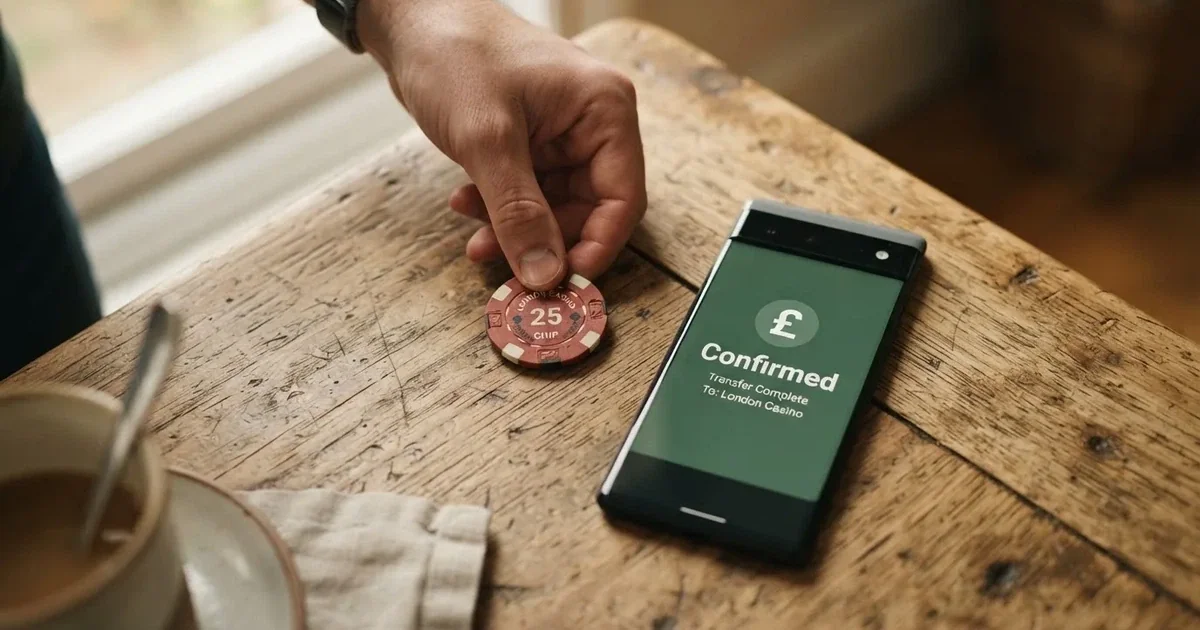
What a £2 minimum deposit casino in the UK actually delivers
 Available in GB
A £2 deposit looks almost too small to take seriously. At a corner shop it buys a lottery ticket and change. At a Gambling Commission-licensed online casino it opens the same game library a £200 deposit opens, plays under the same rules, and pays out through the same rails. The size of the deposit does not change the licence behind it, the GAMSTOP hook in the cashier, or the £2-per-spin stake ceiling that the regulator has fixed for under-25s. What it changes is how much of those rules a player runs into, how long the bankroll survives, and how the cashier behaves when the balance is small. That is the gap between the headline “deposit from £2” and the experience of actually depositing £2, and this page is written to close it.

Last checked against the Gambling Commission’s public register on 23 September 2026, the licence claims below were verified against the register as a reader would consult it.
Table of Contents
- The £2 minimum deposit casino landscape: ten licensed UK operators side by side
- Stake Limits
- Who needs a Gambling Commission licence to take a £2 deposit from a UK player
- Responsible gambling at a £2 minimum deposit casino
- How £2 deposits and the resulting withdrawals actually move
- What a £2 minimum deposit buys in the bonus economy
- What “a £2 minimum deposit casino” actually is, in plain English
- How this page’s figures were checked
- PokerStars
- Betfred
- Betfair
- bet365
- Unibet
- Coral
- Casumo
- 888casino
- kwiff
- Midnite
- What the £2 deposit costs in time and in clearing
- Where a £2 minimum deposit casino sits inside the broader UK market
- Where the £2 deposit stops being the centre of the page
- Frequently asked questions
The £2 minimum deposit casino landscape: ten licensed UK operators side by side
Ten Gambling Commission licensees sit on the comparison below. Every entry below comes from the public register of gambling businesses on 23 September 2026 — the same spreadsheet a reader can download themselves. None of the rows here is a brand the operator set up around a £2 deposit specifically; the threshold sits on the cashier page, not on the licence, and most UK-licensed brands will accept a deposit that small or smaller. The order is the order the register presents them in once you sort by account number, with the smaller, newer licensees pushed to the bottom.

| Brand | Licence holder and GB remote casino licence | Domain status on the register | Subject support |
|---|---|---|---|
| PokerStars | Stars Interactive Limited — 039108-R-319334-026 | Active | — |
| Betfred | Petfre (Gibraltar) Limited — 039544-R-319290-010 | Active | — |
| Betfair | PPB Games Limited — 039411-R-319335-010 | Active | — |
| bet365 | Hillside (UK Gaming) ENC — 055149-R-331499-004 | Active | — |
| Unibet | Platinum Gaming Limited — 045322-R-324275-019 | Active | — |
| Coral | LC International Limited — 054743-R-330863-014 | Active | — |
| Casumo | Recro Limited — 061549-R-336718-002 | Active | — |
| 888casino | 888 UK Limited — 039028-R-319297-014 | Active | — |
| kwiff | Eaton Gate Gaming Limited — 044448-R-323408-017 | Active | — |
| Midnite | Dribble Media Limited — 042647-R-321653-022 | Active | — |
The brand column says what is in the cashier URL. The licence column says the corporate body the regulator actually licenses, which is not always the brand name on the homepage — Petfre (Gibraltar) Limited runs Betfred, PPB Games Limited runs Betfair, Hillside (UK Gaming) ENC runs bet365, LC International Limited also runs Ladbrokes and Gala Bingo, and 888 UK Limited runs 888casino. Several of those licensees sit behind multiple consumer brands and the same GAMSTOP, complaint route and financial vulnerability check applies across all of them. The domain column tracks what the register says the website is doing on the day the CSV was downloaded — Active, Inactive or White Label, where a white-label site trades under another company’s licence.
The subject column is empty by design. None of these ten licensees publishes a £2 minimum-deposit product line that the register captures, and the threshold sits on the cashier page rather than in any licence filing. A row that announces a figure here would be inventing one.
Reading the table as it is meant to be read: every brand above is on the same legal footing, every cashier accepts a deposit of £2 (where the method supports it), and every cashier runs the same GAMSTOP, age and identity gate. The decision is not who is licensed — they all are — it is which cashier a player finds least friction, which payout rail returns the balance in minutes rather than days, and which bonus terms survive the 10x wagering cap that came into force on 19 December 2025.
Stake Limits
| Stake type | Limit | Applies to |
|---|---|---|
| Slot spin | £5 | Players aged 25+ |
| Slot spin | £2 | Players aged 18-24 |
The market is wider than the ten brands on the table above. On 23 September 2026 the Gambling Commission’s public register of gambling businesses listed 139 businesses holding an active remote casino operating licence, and the same register’s domain list held 1065 active and 361 white-label domain entries — a white-label site trades under another company’s licence, so it does not appear in the 139. The 139 is the universe of licensees the Commission itself recognises as active right now; the 1065 is the universe of websites those licensees run. The ten above are a sample, not the population.

The regulation applies to the cashier setting rather than the deposit figure. A Gambling Commission licensee accepts these small deposits whenever the cashier’s own floor permits it. The register does not break licensees out by deposit threshold, because the threshold is a product setting rather than a licence setting — the regulator licenses the operator, the operator sets the minimum. Three things follow from that.
First, the licensee count sets the ceiling on how many genuinely licensed £2 deposit casinos exist. The Commission disrupted 139 licensees into a register, and any of them may carry a £2 minimum on the cashier; the headline number of “£2 deposit casinos” advertised across the web is not the same as the licensee count, because most affiliate lists count domains rather than licensees, and one licensee can run dozens of white-label sites on the same licence number. A reader working from an affiliate count of “over 1000 £2 deposit casinos” is reading the 1065 domain figure and mistaking it for licensees.
Second, the deposit itself is small enough to be legal on rails the regulator already controls. Faster Payments moves a £2 bank transfer from one UK account to another in seconds, debit cards process a £2 chip-and-PIN-equivalent online transaction without a minimum flag, and the credit card ban that has been in force since 14 April 2020 only ever touched credit cards — a £2 deposit on a Visa Debit or Mastercard Debit is unaffected. The payment architecture was never the obstacle to small deposits; the obstacle was the cashier’s own minimum, and that has come down.
Third, the licence number on the register is the receipt. It has the shape account-R-number-suffix, where the leading six digits repeat the licence holder’s account number, the “R” marks a remote (online) licence, and the suffix is the licence slot. The Commission publishes the register as CSV and Excel downloads; a reader can search by brand name and read the licence back from the same line that lists the domain status.
Who needs a Gambling Commission licence to take a £2 deposit from a UK player
Every operator that takes money from a player in Great Britain for remote casino gambling needs a Commission licence, regardless of where the operator is incorporated. The Gambling (Licensing and Advertising) Act 2014 closed the offshore loophole that had allowed operators licensed only in Malta, Gibraltar or Curaçao to advertise into the UK market without a Commission licence. A Curaçao, Maltese or Gibraltar licence is not a substitute. The Commission’s register is the test — a brand on it is licensed, a brand not on it is not, and the 139 licensees on the register on 23 September 2026 are the population to choose from.
Two practical consequences follow. A £2 minimum deposit casino not on the register cannot legally take a UK deposit, regardless of how prominent the offer is; section 33 of the Gambling Act 2005 makes providing gambling to people in Great Britain without a licence an offence. A £2 minimum deposit casino on the register is bound by the same social responsibility code as every other licensee: 18+ only, name, address and date of birth verified before the first deposit or any play (since 7 May 2019), GAMSTOP registration checked, a financial vulnerability check at £150 net deposits in a rolling 30 days, and a prompt to set a financial limit before the first deposit (in force from 31 October 2025).
The offshore picture is sharper than the regulated one. A non-Commission site takes the £2 deposit, processes the gameplay on its own terms, and pays out on its own schedule. The player loses on that site is protection — no GAMSTOP registration is checked, no Commission complaints route exists, no ADR provider is approved by the regulator, no financial vulnerability check fires at £150. The Commission can and does disrupt illegal sites — cease-and-desist notices, search-engine delisting, payment and hosting referrals — but it has no ISP-blocking power, so a site taken down one day often reappears the next. No penalty is aimed at the player; the penalty is the missing safety net.
Responsible gambling at a £2 minimum deposit casino
The Gambler Commission staff call it “safer gambling”, and it carries the same regulatory weight at a £2 deposit casino as it does at a £200 deposit casino. The minimum stake is not a regulated figure — the operator sets it. The maximum stake per game cycle is a regulated figure: £5 for players aged 25 and over from 9 April 2025, and £2 for players aged 18-24 from 21 May 2025. For a 22-year-old, the £2 minimum deposit and the £2 maximum stake line up by accident rather than by design; for a 30-year-old, the £2 minimum deposit sits well below the £5 stake ceiling.
GAMSTOP is the second line of defence, and it is a mandatory condition of every online licence. A player who registers with GAMSTOP — for six months, one year or five years, with no early cancellation — is excluded from every GB-licensed remote operator for the period chosen. The cashier at a licensed site reads the GAMSTOP register before the first deposit. That is the same check at a £2 deposit casino as it is anywhere else, and it is the reason a £2 deposit casino not on GAMSTOP is, by definition, not a GB-licensed remote casino.
The third line of defence is the financial vulnerability check. From 28 February 2025, a licensed cashier runs a public-data financial vulnerability check once a player has net deposited £150 in a rolling 30 days. A £2 deposit never trips that check on its own; it only matters once a player has deposited enough, often enough, to hit the £150 net figure. The check uses public data only — court records, insolvency registers, county court judgments — and the cashier decides what to do with the result. A wider financial risk assessment framework has been announced but is not yet in force, so the £150 net trigger is the active one.
The fourth line is the deposit-limit prompt. From 31 October 2025 every licensed cashier must prompt the customer to set a financial limit before the first deposit. The prompt is mandatory; setting the limit is the player’s call. The prompt does not impose a ceiling — there is no state-set deposit or loss cap at a licensed UK casino — but it does mean the player has to decide, before putting £2 in, whether £2 is part of a daily, weekly or monthly limit, or whether the cashier’s default applies.
The fifth line is the National Gambling Helpline, run by GamCare and funded by GambleAware, and the ADR route that the Commission approves. A complaint that a licensed cashier cannot resolve goes to an ADR provider the Commission has approved; the same route is open to a player who deposited £2 and was paid out late. None of that is open to a player who deposited £2 at an offshore site that did not run the same checks.
How £2 deposits and the resulting withdrawals actually move
A £2 deposit moves through one of three rails: a debit card (Visa Debit, Mastercard Debit), a UK bank transfer over the Faster Payments Service, or an e-wallet (PayPal, Skrill, Neteller, AstroPay). The rail that takes the deposit also takes the payout, with some asymmetry — many e-wallets refuse deposits from credit cards because of the 14 April 2020 credit card ban, and PayPal in particular will reverse a deposit funded by credit card regardless of which side of the cashier the transaction sits on. Debit cards and bank transfers never tripped the credit card ban, and a £2 deposit on either rail clears the same way a £200 deposit clears.
Bank transfers are the rail to watch for speed. The Faster Payments Service, launched in 2008 and operated by Pay.UK, runs 24 hours a day, seven days a week, and most payments arrive instantly or within a couple of minutes, with occasional transfers taking up to two hours. The scheme’s per-transaction limit is £1,000,000, well above the £2 in question, though individual banks can and do impose lower limits on their own customers. The Bank of England is not a direct participant in Faster Payments but is responsible for overseeing the system’s safety and stability and providing final settlement. For a £2 payout, that means the cashier hits “pay”, the money leaves the operator’s bank account, and the player’s bank balance updates inside two hours — usually inside the minute.
Debit cards run slower on the way out than on the way in. A £2 deposit on Visa Debit or Mastercard Debit clears instantly; a £2 withdrawal back to the same card typically takes two to five working days because the card networks were built to push money back through the acquiring bank rather than through a Faster Payments-style instant rail. Some licensed cashiers quote “instant withdrawals to debit card” and rely on a card-network fast-refund feature that is not available on every card and not on every issuer. A reader who treats “instant withdrawal” as a guarantee rather than a feature flag will be disappointed on the first cash-out.
E-wallets sit between the two. PayPal deposits are usually instant, withdrawals are usually inside 24 hours but can be longer if PayPal holds the payment for review. AstroPay is the more interesting case for a £2 deposit casino: AstroPay was founded in 2009 and is headquartered in Uruguay, and operates as a global digital wallet offering online payments, virtual and physical debit cards, and peer-to-peer transfers. AstroPay spun off its payment-processing business, dLocal, as a separate company in 2016. AstroPay’s UK entity, Larstal Limited, is an electronic money institution authorised by the Financial Conduct Authority under the Electronic Money Regulations 2011; its Isle of Man entity is licensed by the Isle of Man Financial Services Authority for money transmission; its Brazilian entity, Astro Instituição de Pagamento Ltda, is authorised by the Brazilian Central Bank as an electronic currency issuer; its Danish entity, Larstal Denmark ApS, is authorised as an electronic money institution by the Danish Financial Supervisory Authority. AstroPay serves users across markets including Argentina, Australia, Brazil, Canada, Colombia, Denmark, Spain, the United Kingdom, the United States and Uruguay. None of that licensing changes the position at a UK cashier: AstroPay is an e-money route, not a UK gambling licence, and the cashier still needs its own Gambling Commission licence to take a UK deposit.
Apple Pay is a special case. Apple Pay is developed and operated by Apple Inc. and launched on 20 October 2014, initially supporting only US-issued payment cards. Apple Pay began supporting UK-issued payment cards on 14 July 2015. Apple Pay protects card data through tokenization, replacing the actual card number with a device-specific tokenised Device Primary Account Number and generating a dynamic security code for each transaction. Apple Pay in-store payments use near-field communication (NFC) to communicate wirelessly with contactless payment terminals. Apple states that a supported card from a participating card issuer is required to use Apple Pay, and that Apple Pay is not available in all markets. On an iPhone with Face ID, Apple Pay in-store purchases are authenticated by double-clicking the side button; on models with Touch ID, by double-clicking the Home button. None of that is relevant to a £2 deposit at a UK cashier, where Apple Pay sits behind the cashier’s debit-card processing and is treated as a Visa Debit or Mastercard Debit transaction. The cashier’s own minimum applies on top.
What a £2 minimum deposit buys in the bonus economy
A £2 minimum deposit casino in the UK is also a £2 minimum bonus-claim casino, if the cashier allows bonuses at that level. The bonus terms are where the £2 stake starts to feel small, because every figure in the bonus economy is sized for a deposit an order of magnitude larger.
The regulator’s stake in this is direct. Since 19 December 2025, wagering requirements on casino bonuses are capped at 10x — meaning a £20 bonus can carry at most £200 of required turnover before the bonus converts to withdrawable cash. The same reform banned mixed-product bonuses, where a sports bet comes with attached casino spins; if a player wanted spins they now come with their own wagering terms, or they come as a standalone offer. The 10x cap is a number a reader can hold in their head, and it is the number to multiply any advertised bonus by when comparing offers.
Consider a £20 bonus with a 10x wagering requirement. The bonus requires £200 of qualifying turnover. At a slot with a £0.10 stake per spin, that is 2000 spins. At 2.5 seconds per spin, 2000 spins take approximately 83 minutes. This duration is typical for this bonus type and compliant with the regulator’s rules.
A £2 minimum deposit, by contrast, makes the same bonus math awkward. A 100% match on a £2 deposit is a £2 bonus with a £20 wagering requirement, which is 20 spins at £1 or 200 spins at £0.10, plus the same button-press cadence. The bonus is not financially impossible to clear; it is just small enough that the time and the friction start to outweigh the upside. A cashier that gates its welcome offer at a £10 minimum deposit is not enforcing a £2 minimum because it wants to push small-stake players away — it is enforcing the £10 minimum because the bonus it wants to advertise is not a sensible product at a £2 deposit.
This is where the wagering cap shows up most clearly. The 10x cap was set at a level that keeps large deposit bonuses from bleeding the player dry. It was not set to make small deposit bonuses meaningful, because small deposit bonuses were not the regulatory target. A reader looking at a £2-deposit welcome offer is reading a product that the regulator has shaped for the £100-deposit welcome offer, and the numbers do not scale down evenly.
The regulator’s view, in plain terms: the wagering cap is the line at which a casino bonus stops being a serious financial product for the player. Below the line, the bonus is a free trial of the cashier. Above the line, the bonus is a financial commitment the cashier has a duty to disclose. A £2 deposit casino in the UK is the former case more often than the latter, and that is the shape of the bonus economy the reader is stepping into.
What “a £2 minimum deposit casino” actually is, in plain English
The phrase has three layers, and they collapse easily into one. The first layer is the cashier’s own minimum — the floor at which the cashier will accept a deposit, set by the operator rather than the regulator. The second layer is the regulation around the cashier — the licence, the GAMSTOP hook, the age and ID check, the financial vulnerability check, the deposit-limit prompt. The third layer is the bonus product on top of the cashier — the welcome offer, the wagering requirement, the game weighting, the maximum cashout.
A £2 minimum deposit casino in the UK is, in practice, a Gambling Commission licensee whose cashier has set its minimum deposit to £2. That is the whole of layer one. Layers two and three are independent of the £2 figure: a £2-deposit cashier at a Commission licensee carries the same GAMSTOP, ID check, vulnerability check, and deposit-limit prompt that any other Commission licensee carries, and any bonus product the cashier advertises carries the same wagering cap and game weighting that any other Commission licensee’s bonus product carries.
A reader who arrives at a £2 deposit casino through an affiliate link and finds the cashier’s real minimum is £5, £10 or £20 has not been misled about the licence — they have been misled about the cashier’s product. The cashier’s minimum is the only figure that varies, and the cashier’s minimum is the only figure the regulator does not set.
How this page’s figures were checked
Every licence number on the comparison table came from the Gambling Commission’s public register of gambling businesses, downloaded as a CSV on 23 September 2026. The same download produced the 139-licensee count and the 1065-active and 361-white-label domain counts. The Faster Payments figures came from a UK bank’s published explanation of the scheme, the credit card ban date came from the Commission’s own announcement, and the wagering cap date came from the LCCP update published on 19 December 2025. The AstroPay licensing chain came from AstroPay’s own “About us” page on 23 September 2026. None of those sources is an affiliate or a marketer; all of them are the entities the regulator, the operator or the payment scheme themselves run.
Where the register shows an entry, the entry has the form the Commission specifies: account-R-number-suffix, where the leading six digits repeat the licence holder’s account number, the “R” marks a remote (online) licence, and the suffix is the licence slot. A reader who wants to check the table themselves can search the register by brand name and read the licence back from the same line that lists the domain status.
PokerStars
Stars Interactive Limited holds Gambling Commission remote casino operating licence 039108-R-319334-026, and the public register lists Pokerstars.uk as an active domain of account 39108. The brand is best known for poker, but the cashier also runs slots, table games and live dealer, and the same Commission licence covers the casino side as it does the poker side. The cashier accepts a £2 minimum deposit on the standard UK payment rails, and the GAMSTOP, age and ID gates apply the same way they would on any other Commission licensee.
The £2 deposit at PokerStars plays inside a stake envelope that the regulator sets. The bonus terms here follow the industry-standard 10x wagering cap. PokerStars is one of the places where the math lines up without forcing a choice between them.
The verdict: PokerStars suits players who already enjoy the poker platform and want the casino under the same licence. It is not the strongest £2 deposit casino for a reader who has not played there before, because the cashier’s welcome bonus product is built around deposits of £10 or more and a £2 deposit lands outside the bonus envelope.
Betfred
Petfre (Gibraltar) Limited holds Gambling Commission remote casino operating licence 039544-R-319290-010, and the public register lists Betfred.com as an active domain of account 39544. The brand runs a UK bookmaker’s online casino alongside its high-street shops. The £2 deposit at Betfred is the cashier’s own minimum, with standard bonus terms applied.
Betfred is a solid pick for those who already use a Betfred shop account and want to unify their digital play. The high-street bookmaker pedigree is the one thing the cashier offers that the rest of the table does not — the same brand runs both sides of the same wallet, and the £2 deposit at the cashier can sit alongside an existing shop account without creating a parallel identity.
The verdict: Betfred is a competent £2 deposit casino whose strongest pitch is to readers already inside the brand. A first-time reader will not lose anything by starting there, but the cashier’s welcome offer is sized for a deposit materially larger than £2 and the £2 deposit does not unlock the offer’s headline terms.
Betfair
PPB Games Limited holds Gambling Commission remote casino operating licence 039411-R-319335-010, and the public register lists Betfair.com as an active domain of account 39411. The brand runs an exchange sportsbook alongside its casino. The £2 deposit at Betfair is the cashier’s own minimum, adhering to the 10x wagering limit.
Betfair attracts those who view the casino as an add-on to exchange betting. The exchange product is the brand’s main draw; the casino product is the side that picks up the £2 deposit. The same wallet runs both products, the same GAMSTOP gate sits in front of both, and the £2 deposit at the cashier is the cheapest way to try the casino side without committing more than the regulator’s minimum.
The verdict: Betfair is a £2 deposit casino for a reader who is on the exchange anyway. A reader whose interest is only in the casino side will find a more casino-focused cashier elsewhere on the table.
bet365
Hillside (UK Gaming) ENC holds Gambling Commission remote casino operating licence 055149-R-331499-004, and the public register lists Bet365.com as an active domain of account 55149. The brand runs one of the largest UK-facing online gambling operations. The £2 deposit at bet365 is the cashier’s own minimum, compliant with standard wagering rules.
bet365 is the £2 deposit casino for a reader who values a deep game library. The cashier’s slots catalogue is one of the widest on the table, and a £2 deposit opens the full library rather than a stripped-down version. The cashier’s payout timings depend on the rail chosen: bank transfer over Faster Payments is the fastest, debit-card withdrawal is the slowest, and the e-wallet rails sit in the middle. None of that is different from the rest of the table.
The verdict: bet365 is the £2 deposit casino for a reader who wants the deepest catalogue and the broadest payment coverage. It is also the choice where the £2 deposit represents only a small fraction of the cashier’s available options.
Unibet
Platinum Gaming Limited holds Gambling Commission remote casino operating licence 045322-R-324275-019, and the public register lists unibet.co.uk as an active domain of account 45322. The brand runs a casino, sportsbook and poker product. The £2 deposit at Unibet is the cashier’s own minimum, with terms within the 10x cap.
Unibet serves multi-product users who appreciate a unified wallet experience. The same wallet covers the casino, the sportsbook and the poker product, and the same GAMSTOP gate sits in front of all three. The £2 deposit at the cashier opens the casino side without committing to a deposit that would unlock the sportsbook’s headline offer.
The verdict: Unibet is a competent £2 deposit casino whose strongest pitch is to readers already on the sportsbook. The cashier’s welcome offer is built for deposits larger than £2, and a £2 deposit is a way to test the casino side without making a larger commitment.
Coral
LC International Limited holds Gambling Commission remote casino operating licence 054743-R-330863-014, and the public register lists coral.co.uk as an active domain of account 54743. The same licensee also runs Ladbrokes and Gala Bingo, sharing a wallet and GAMSTOP gate. The £2 deposit at Coral is the cashier’s own minimum, featuring standard 10x wagering terms.
Coral is a strong option for fans of the multi-brand wallet shared with Ladbrokes. The high-street bookmaker pedigree is the brand’s strongest pitch; the online casino product is the side that picks up the £2 deposit.
The verdict: Coral is a £2 deposit casino whose strongest pitch is the multi-brand wallet. A reader with no prior relationship to LC International Limited’s brands will find a comparable product elsewhere on the table.
Casumo
Recro Limited holds Gambling Commission remote casino operating licence 061549-R-336718-002, and the public register lists Casumo.com as an active domain of account 61549. Casumo focuses on casino games. The £2 deposit at Casumo is the cashier’s own minimum, subject to the standard 10x wagering rule.
Casumo appeals to players who prioritize a dedicated casino focus without sportsbook distractions. The brand does not run an exchange sportsbook or a poker product on the same Commission licence, and the cashier is built around slots, table games and live dealer. The £2 deposit at the cashier opens the same library a £200 deposit opens, and the cashier’s bonus product is the one that matters most because there is no sportsbook or poker product to divert attention.
The verdict: Casumo is a strong £2 deposit casino for a reader who wants the casino side without the sportsbook or the poker side bolted on. The brand’s narrower focus is also its pitch.
888casino
888 UK Limited holds Gambling Commission remote casino operating licence 039028-R-319297-014, and the public register lists 888casino as an active domain of account 39028. 888casino is a long-running brand. The £2 deposit at 888casino is the cashier’s own minimum, adhering to the 10x wagering cap.
888casino serves players seeking a long-standing brand with a verified track record. The brand has held a Commission licence since the early days of the UK-regulated online market, and the cashier’s product is built around the casino side. The same GAMSTOP, age and ID gates apply, the same financial vulnerability check fires at £150 net deposits in a rolling 30 days, and the cashier’s bonus product sits inside the 10x cap.
The verdict: 888casino is a £2 deposit casino whose strongest pitch is longevity. A reader who values a long Commission record over a deep product catalogue will find the brand well placed.
kwiff
Eaton Gate Gaming Limited holds Gambling Commission remote casino operating licence 044448-R-323408-017, and the public register lists Kwiff.com as an active domain of account 44448. kwiff is one of the smaller licensees on the table, and the cashier takes the standard UK payment rails. The £2 deposit at kwiff is the cashier’s own minimum, and the cashier’s bonus product sits inside the 10x wagering cap.
kwiff is the £2 deposit casino for a reader who wants a smaller licensee with a tighter product focus. The brand does not run a sportsbook or an exchange product on the same Commission licence, and the cashier is built around the casino side. The £2 deposit at the cashier opens the same library a £200 deposit opens, and the cashier’s bonus product is the one that matters most.
The verdict: kwiff is a competent £2 deposit casino for a reader who values a smaller licensee over a multi-product brand. The cashier’s product is narrower than bet365’s or Casumo’s, and a reader who wants a deep catalogue will look elsewhere.
Midnite
Dribble Media Limited holds Gambling Commission remote casino operating licence 042647-R-321653-022, and the public register lists Midnite.com as an active domain of account 42647. Midnite is the most recently licensed brand on the table, and the cashier takes the standard UK payment rails. The £2 deposit at Midnite is the cashier’s own minimum, and the cashier’s bonus product sits inside the 10x wagering cap.
Midnite appeals to those looking for a newer licensee. The brand’s Commission licence is shorter in standing than the rest of the table, but the cashier is bound by the same GAMSTOP, age and ID gates, the same financial vulnerability check, and the same 10x wagering cap as every other Commission licensee. The £2 deposit at the cashier opens the same library a £200 deposit opens.
The verdict: Midnite is a £2 deposit casino whose strongest pitch is being the newest entrant on the table. A reader who values a long Commission record will find the brand at the bottom of the table for that metric; a reader who values a tighter product focus will find the brand closer to the top.
What the £2 deposit costs in time and in clearing
The arithmetic the regulator has set is mechanical, and it is worth following once because it sets the floor for what a £2 deposit casino bonus actually asks of a player.
A 10x wagering requirement on a £2 bonus is £20 of qualifying turnover. At a £1 stake per spin, that is 20 spins. At a £0.10 stake per spin, that is 200 spins. At the regulated 2.5-second minimum spin interval, 20 spins take roughly 50 seconds of button-presses; 200 spins take roughly 8 minutes 20 seconds. Auto-play is banned, so each spin is a deliberate press.
A 10x wagering requirement on a £20 bonus requires £200 of qualifying turnover. At a £0.10 stake per spin, that is 2000 spins. At 2.5 seconds per spin, 2000 spins take approximately 83 minutes. This duration is typical for this bonus type and compliant with the regulator’s rules.
The cashier’s bonus product is sized for the second scenario. A £2 deposit is the floor of the cashier’s product rather than the centre, and the wagering requirement on a £2 bonus is small enough that the time cost is measured in minutes rather than hours. The expected loss to the player on the bonus turnover is a separate figure — turnover multiplied by the house edge — and it scales the same way the time scales. The point for a £2 deposit is that the bonus is small enough to be a free trial of the cashier, and that is the position the regulator has put the £2 deposit bonus in.
A £2 minimum deposit casino in the UK is therefore not a product designed around the £2 deposit. It is a cashier whose floor is £2, sitting on top of a regulation that does not care whether the deposit is £2 or £200. The £2 deposit opens the cashier the same way a £200 deposit opens it. The bonus product that the cashier advertises is the product the cashier wants to sell, and the £2 deposit is the smallest unit at which the cashier will sell it.
Where a £2 minimum deposit casino sits inside the broader UK market
The 139 licensees on the register on 23 September 2026 are not the same list as the £2-deposit-friendly sites an affiliate aggregator might surface. The aggregator’s list will count domains rather than licensees, and the same licensee can run multiple domains — the LC International Limited row on the table above covers three consumer brands, and the 888 UK Limited row sits behind multiple regional sites. A reader counting “over 1000 £2 deposit casinos” is reading a number closer to the 1065 active domain figure than to the 139 licensee figure.
The credit card ban that has been in force since 14 April 2020 only ever touched credit cards. The Commission’s estimate at the time was that around 800,000 UK consumers used credit cards to gamble in 2018, and 22% of online gamblers who used credit cards to gamble were classed as problem gamblers. The figure is from the Commission’s own announcement and is the basis for the ban. The 14 April 2020 date is the date the ban came into force, and it has not been lifted.
The 10x wagering cap that came into force on 19 December 2025 is the most recent change to the bonus economy. The cap applies to all GB-licensed casino bonuses; it does not apply to free spins with no wagering requirement, which is a different product. The 10x figure is the cap, not a floor — a cashier can offer a bonus with a 1x wagering requirement, but cannot offer one with an 11x requirement. The mixed-product bonus ban that came in at the same time ended the practice of attaching casino spins to a sports bet.
The slot-stake caps that came in on 9 April 2025 (£5 for 25+) and 21 May 2025 (£2 for 18-24) are the regulated figures that a £2 minimum deposit casino has to live inside. A £2 deposit casino that markets itself to under-25s will see the £2 stake ceiling line up by accident with the £2 minimum deposit; a £2 deposit casino that markets itself to over-25s will see a £5 stake ceiling that the £2 deposit does not approach.
The deposit-limit prompt that came in on 31 October 2025 is the most recent change to the cashier’s onboarding flow. The prompt is mandatory; setting the limit is the player’s call. The state does not impose a ceiling — there is no state-set deposit or loss cap at a licensed UK casino — but the player has to decide, before putting £2 in, whether to set a limit or accept the cashier’s default.
Where the £2 deposit stops being the centre of the page
A £2 minimum deposit is a cashier setting rather than a regulated figure, and the cashier is only one layer of a £2 minimum deposit casino. The GAMSTOP, age and ID, financial vulnerability and deposit-limit prompts all fire regardless of the deposit size. The bonus economy is sized for deposits an order of magnitude larger than £2. The slot stake ceiling for under-25s happens to be £2, but that is a coincidence of the regulator’s tiering rather than a design choice by the cashier. The Faster Payments rail is the fastest payout method for a £2 withdrawal, but Faster Payments does not care whether the withdrawal is £2 or £2,000.
What this means for a reader: the £2 deposit is the floor at which the cashier opens, and the regulation around the cashier is the same regardless of whether the player puts £2 in or £200 in. A reader who treats the £2 deposit as the centre of the offer is reading the cashier’s product rather than the regulated product, and the regulated product is the one that determines whether the cashier is safe, whether the cashier is licensed, and whether the cashier can take a UK deposit at all.
The £2 minimum deposit casino in the UK is, in short, any of the 139 Commission licensees whose cashier accepts a £2 deposit. The regulation does not change. The cashier’s product does. The £2 deposit opens the same library a £200 deposit opens, plays under the same rules, and pays out through the same rails — Faster Payments on the way in and on the way out, debit cards slower on the way out than on the way in, e-wallets sitting in between. The bonus product is sized for a deposit materially larger than £2, and the wagering cap of 10x is the line the cashier cannot cross.
Frequently asked questions
What counts as a £2 minimum deposit at a licensed UK casino?
It is a cashier-level setting rather than a regulated figure. The cashier’s minimum deposit is the floor at which the cashier will accept money; the operator sets it, not the Gambling Commission. A £2 minimum deposit at a licensed UK casino is any Commission licensee whose cashier accepts a deposit of £2 on at least one payment rail.
Is a £2 minimum deposit casino safe to use?
Safety at a £2 deposit casino is the same as safety at a £200 deposit casino, because the safety layer sits above the cashier’s minimum. Every Commission licensee runs GAMSTOP, age and ID checks, a financial vulnerability check at £150 net deposits in a rolling 30 days, and a deposit-limit prompt before the first deposit. A £2 deposit that lands at a Commission licensee is as safe as a £2 deposit can be in the UK.
Can I find a £2 minimum deposit casino that isn’t on GAMSTOP?
A £2 minimum deposit casino not on GAMSTOP is, by definition, not a GB-licensed remote casino. GAMSTOP has been a mandatory condition of every online licence since 31 March 2020, and the cashier at every Commission licensee reads the GAMSTOP register before the first deposit. A site that skips GAMSTOP either holds no UK licence or holds a licence from a jurisdiction that does not require it, and either way it sits outside the regulated UK market.
How quickly do withdrawals settle after a £2 deposit?
The withdrawal speed depends on the payment rail rather than the deposit size. Bank transfers over the Faster Payments Service typically arrive instantly or within a couple of minutes, with occasional transfers taking up to two hours. Debit-card withdrawals typically take two to five working days because the card networks were built to push refunds through the acquiring bank. E-wallet withdrawals usually settle inside 24 hours but can be longer if the wallet provider holds the payment for review.
Which payment methods accept a £2 minimum deposit?
Debit cards (Visa Debit, Mastercard Debit), UK bank transfers over the Faster Payments Service, and most e-wallets including PayPal, Skrill, Neteller and AstroPay. Credit cards are banned for gambling since 14 April 2020 and never formed part of the £2 deposit set. Apple Pay sits behind the cashier’s debit-card processing and is treated as a Visa Debit or Mastercard Debit transaction. The cashier’s own minimum applies on top, and a £2 minimum at the cashier means £2 across whichever rail the cashier supports.
Is a £2 minimum deposit casino licensed by the Gambling Commission?
The cashier’s minimum is not the licence. The licence is the Gambling Commission’s, and the test is the register. A brand whose domain appears on the register on 23 September 2026 with an Active status holds a Commission licence; a brand whose domain does not appear does not. The £2 minimum is set by the cashier after the licence is issued.
Prepared by the casinoratingsuk editorial staff.